I think it's pretty simple. If a soundtrack was originally done for two-channel, then you play it back in two-channel. If it was mixed for surround, then you're best served playing it back with a surround setup.

The thing about surround music is that it's really in its infancy. Sound engineers are just learning how to work with the new medium and already you see a lot of compelling examples of what's possible with 5.1 channels. Some are good, some are bad, some are mixed to make it sound like you're in a concert hall, others are mixed to put you into a completely different world of sound. It's like the early days of stereo where the early recordings took some wildly different approaches. Just as some of the left to right panning effects in early stereo recordings now sound cheesy, I'm sure that some of the early attempts at surround music won't be looked upon too favorably 50 years from now.

And even now, there's disagreement as to the best approach to surround music. Some producers and engineers prefer to mix without the center channel active, some prefer to go full range on all channels and keep the subwoofer track silent, some recordings put you in the audience near the back of the room, some recordings put you inside of the instrument. All I know is that the better surround music recordings are very compelling. Audiophiles typically look for loosely defined attributes such as imaging, soundstaging, "air", etc. and the better surround recordings provide all of these qualities in abundance and sometimes better than with any high end two channel setup I've ever heard. If you listen to a high quality surround recording and cannot denote these attributes, then you need to make sure that the system is setup correctly.

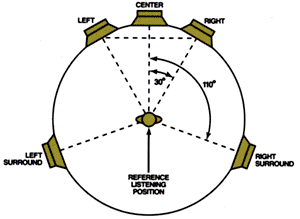
In order to get the maximum benefit from surround music, two factors are absolutely critical -- speaker placement and timbre matching. The studio monitoring setup with surround music mixing is typically done in the ITU multichannel reference configuration (diagram below)


Ideally, you would setup your speakers in this configuration as well. Placement with a surround system is more difficult to get right just by tweaking than with two speakers, so this is where you should start.

If you plan on also using your setup with movies, you should make a compromise by raising the surround speakers at least 1' above ear level and pointing them directly at one another. This is the configuration that Dolby recommends for home systems used for both surround music and movies because it retains the precise imaging mixed into surround music mixes while imparting some diffused sound with ambient movie sound effects. If the surround speakers are closer to your ear than the mains, then you need to increase the delay time to the surrounds.

Timbre matching is also absolutely critical if you want to hear what surround music is capable of. With movie soundtracks, the sound that gets sent into the surrounds is not often mixed at the same levels as the front, and more often the sounds that go into the surrounds are ambient effects separate from what's going on up front. Timbre matching in this case is still desirable, but not crucial. (Although more and more, you see much more aggressive sound mixes with movies that steer a lot of the music and action from the front three speakers into the surrounds)

With surround music (including a lot of concert DVDs), the surround channels very often get the lead instruments and vocals at roughly the same level as the mains. Any timbre mismatches significantly diminish the imaging quality. When I timbre matched my system after going almost two years with mismatched surrounds, surround music soundtracks gained an almost eerie three dimensionality. The soundstage across the front is now exceptionally wide, and the side imaging is solidly anchored in a way that's impossible for two-channels to achieve.

Aside from the higher resolution that topspeed also mentioned, surround music has further benefits in that the 5.1 mixes require going all the way back to the multitracked master tapes. In many cases, the two-channel "master" tape was originally prepared with the vinyl medium in mind, and got directly transferred to CD without any other preparation (which explains why so many early CD transfers sounded harsh and tinny compared to the LP versions). With new 5.1 mixes, the soundtrack can now be done specifically with a high res digital format in mind.