Page 6 of 17 FirstFirst ... 4 5 6 7 8 16 ... LastLast
Results 126 to 150 of 415
  1. #126
    Forum Regular
    Join Date
    Nov 2003
    Posts
    884
    Quote Originally Posted by Sir Terrence the Terrible
    They can measure poorly and still meet an individuals taste. A speaker that has excellent measurements usually sound better to many people, not just an individual.
    In many ways, dipole speakers do not perform the same way in rooms that forward radiating speakers do because of the fact that the back wave is of opposite polarity to the front wave. John Atkinson's suite of measurements for Stereophile is not particularly well suited to dipole speakers. A few things come to mind. The anechoic or quasi-anechoic curves may show a big peak in the bass which is not there in the room measurements. Some of them are fairly well balanced in a room. The back wave can offer a pleasing spaciousness. Also, out to the sides, the front and back wave cancel each other out pretty well.

    I found Quad ESL-63s to be very placement sensitive but they can sound very good on a lot of music. However, bass balance is difficult and it is hard to get piano and male vocals to sound right.

    On the other hand, my current monitors are more accurate, are easier to place, have a much wider sweet area, and it is easy to get male vocals and piano to sound good. Some recordings that were problematic on the Quads sound fine on them.
    "Opposition brings concord. Out of discord comes the fairest harmony."
    ------Heraclitus of Ephesis (fl. 504-500 BC), trans. Wheelwright.

  2. #127
    M.P.S.E /AES/SMPTE member Sir Terrence the Terrible's Avatar
    Join Date
    Jul 2002
    Posts
    6,826
    Quote Originally Posted by Pat D
    In many ways, dipole speakers do not perform the same way in rooms that forward radiating speakers do because of the fact that the back wave is of opposite polarity to the front wave. John Atkinson's suite of measurements for Stereophile is not particularly well suited to dipole speakers. A few things come to mind. The anechoic or quasi-anechoic curves may show a big peak in the bass which is not there in the room measurements. Some of them are fairly well balanced in a room. The back wave can offer a pleasing spaciousness. Also, out to the sides, the front and back wave cancel each other out pretty well.

    I found Quad ESL-63s to be very placement sensitive but they can sound very good on a lot of music. However, bass balance is difficult and it is hard to get piano and male vocals to sound right.

    On the other hand, my current monitors are more accurate, are easier to place, have a much wider sweet area, and it is easy to get male vocals and piano to sound good. Some recordings that were problematic on the Quads sound fine on them.
    Being a HT installer for many years(acoustical and speaker placement and setup), I am very familiar with how dipoles measure. IMO, you really have to use a combined speaker/room measurement to really understand what the speaker is doing. The problem with dipoles is when you do find room born problems, they are really hard to correct without killing the speakers pure frequency response.

    Personally, I don't like the artificial spaciousness of in room reflections coming from my front speakers, which is why I usually choose speakers with more controlled directivity. They require less room treatments, are easier to place, have less room borne colorations, and sound better overall to me.
    Sir Terrence

    Titan Reference 3D 1080p projector
    200" SI Black Diamond II screen
    Oppo BDP-103D
    Datastat RS20I audio/video processor 12.4 audio setup
    9 Onkyo M-5099 power amp
    9 Onkyo M-510 power amp
    9 Onkyo M-508 power amp
    6 custom CAL amps for subs
    3 custom 3 way horn DSP hybrid monitors
    18 custom 3 way horn DSP hybrid surround/ceiling speakers
    2 custom 15" sealed FFEC servo subs
    4 custom 15" H-PAS FFEC servo subs
    THX Style Baffle wall

  3. #128
    Suspended
    Join Date
    Mar 2002
    Location
    St. Louis, MO, USA
    Posts
    10,176
    If you don't have some standard to abide by, then you are guaranteed chaos. This is why there are standards for film presentation, standards for speaker placement, standards for proper calibration of your speakers and video display devices. With a standard, you can make recordings that are transferable from speaker to speaker.

    One of the best things I learned from Bob Hoda is that you use identical equalization curves for every listening room you have, and regardless of the speakers you use. That way you are much closer to what is heard in the recording studio no matter what system you play the recording on, and no matter which room it sits in.[/QUOTE]

    Are you talking about EQ of the master? At first read your comment sounds absurd If I analyse my room and set the EQ, the same EQ curve would make havoc in your room. That's sort of the point of EQ is to attempt to correct room interactions and since not many rooms are the same a single EQ curve defeats that purpose. I believe a single EQ curve would equate to no tone controls at all.

  4. #129
    Suspended PeruvianSkies's Avatar
    Join Date
    Oct 2006
    Posts
    3,373

    My specs...

    Can someone who knows more about the graphs tell me more about my main speakers?

    http://www.soundstagenetwork.com/mea...b_platinum_t6/


    I understand most of this, but not all of it and really didn't do much research into the graphs when I bought them, I demoed dozens of speakers before I bought these and they were the first speaker in my budget at the time that disappeared and allowed me to fall in love with all the music I heard through them.

    I have yet to find a speaker in their price range or nearly twice their price that is comparable to me, but everyone has different taste.

  5. #130
    RGA
    RGA is offline
    Forum Regular
    Join Date
    Nov 2003
    Posts
    5,539
    Deleted - I won't discuss the topic with people who don't audition. enjoy your speakers
    Last edited by RGA; 07-27-2010 at 08:52 AM.

  6. #131
    RGA
    RGA is offline
    Forum Regular
    Join Date
    Nov 2003
    Posts
    5,539
    deleted - enjoy your speakers
    Last edited by RGA; 07-27-2010 at 08:51 AM.

  7. #132
    Silence of the spam Site Moderator Geoffcin's Avatar
    Join Date
    May 2003
    Location
    NY
    Posts
    3,326
    Quote Originally Posted by PeruvianSkies
    Can someone who knows more about the graphs tell me more about my main speakers?

    http://www.soundstagenetwork.com/mea...b_platinum_t6/


    I understand most of this, but not all of it and really didn't do much research into the graphs when I bought them, I demoed dozens of speakers before I bought these and they were the first speaker in my budget at the time that disappeared and allowed me to fall in love with all the music I heard through them.

    I have yet to find a speaker in their price range or nearly twice their price that is comparable to me, but everyone has different taste.
    I think this thread is too limited to go over the suite of specs on your speaker. From a cursory view though they are not only comprehensive, but quite stellar!
    Audio;
    Ming Da MC34-AB 75wpc
    PS Audio Classic 250. 500wpc into 4 ohms.
    PS Audio 4.5 preamp,
    Marantz 6170 TT Shure M97e cart.
    Arcam Alpha 9 CD.- 24 bit dCS Ring DAC.
    Magnepan 3.6r speakers Oak/black,

  8. #133
    Shostakovich fan Feanor's Avatar
    Join Date
    Jun 2002
    Location
    London, Ontario
    Posts
    8,127
    Quote Originally Posted by Sir Terrence the Terrible
    They can measure poorly and still meet an individuals taste. A speaker that has excellent measurements usually sound better to many people, not just an individual.
    As mentioned already, this is a fact scientifically proven by Floyd Toole.

  9. #134
    It's just a hobby
    Join Date
    Oct 2004
    Location
    London, UK
    Posts
    808

    Could you elaborate

    Quote Originally Posted by RGA
    I am not going to go further down the AN measurements spectrum - The big ass thread that dealt with it at the time is here - Fortunately poster Donald North solved the issue showing JA was clearly wrong and if he's wrong about that he's wrong about other things. http://db.audioasylum.com/cgi/m.mpl?...peter+qvortrup
    As Pat D said earlier it seems you do not understand measurements at all. Worse still, you want to have your cake and eat it, could you elaborate on why JA measurements are clearly wrong. Earlier in the thread Feanor pointed out a potential problem with AN-E design, JA measurements merely confirm it. The quasi-anechoic measurements are cleaner but its pretty clear that this speaker is idiosyncratic.
    It's a listening test, you do not need to see it to listen to it!

  10. #135
    M.P.S.E /AES/SMPTE member Sir Terrence the Terrible's Avatar
    Join Date
    Jul 2002
    Posts
    6,826
    Quote Originally Posted by Mr Peabody
    Are you talking about EQ of the master? At first read your comment sounds absurd If I analyse my room and set the EQ, the same EQ curve would make havoc in your room.
    You cannot EQ the master sitting in your home, it is already done in the studio. You don't have access to the master in your home.

    So we get this really clear, when I speak of EQ, I am talking about frequencies under 200hz, which is the point at which the room becomes more dominate than the output of the speakers.

    In all of my rooms I EQ for a flat response from 40-200hz, and provide a 6db per octave rise to create a house curve under 40hz down to 20hz which coincides with our hearing insensitivies at lower frequencies. Everyone of my systems has this frequency curve, so most recordings (except its spatial presentation) sound pretty much the same from system to system. All of the speakers I have chosen have a pretty flat frequency response in the anechoic chamber, so most of the problem I have with them are room related.


    That's sort of the point of EQ is to attempt to correct room interactions and since not many rooms are the same a single EQ curve defeats that purpose. I believe a single EQ curve would equate to no tone controls at all.
    Correcting room interactions is exactly why I use EQ, but I also use EQ to create a house curve that is tranferable from room to room. Some rooms may need more EQ than others to acheive this goal. The goal in the end is to have rooms that have equal frequency curves, even if the size of the rooms are completely different. This takes a lot of measurements and patience to acheive.
    Sir Terrence

    Titan Reference 3D 1080p projector
    200" SI Black Diamond II screen
    Oppo BDP-103D
    Datastat RS20I audio/video processor 12.4 audio setup
    9 Onkyo M-5099 power amp
    9 Onkyo M-510 power amp
    9 Onkyo M-508 power amp
    6 custom CAL amps for subs
    3 custom 3 way horn DSP hybrid monitors
    18 custom 3 way horn DSP hybrid surround/ceiling speakers
    2 custom 15" sealed FFEC servo subs
    4 custom 15" H-PAS FFEC servo subs
    THX Style Baffle wall

  11. #136
    RGA
    RGA is offline
    Forum Regular
    Join Date
    Nov 2003
    Posts
    5,539
    deleted - enjoy your speakers.

  12. #137
    Silence of the spam Site Moderator Geoffcin's Avatar
    Join Date
    May 2003
    Location
    NY
    Posts
    3,326
    Quote Originally Posted by theaudiohobby
    As Pat D said earlier it seems you do not understand measurements at all. Worse still, you want to have your cake and eat it, could you elaborate on why JA measurements are clearly wrong. Earlier in the thread Feanor pointed out a potential problem with AN-E design, JA measurements merely confirm it. The quasi-anechoic measurements are cleaner but its pretty clear that this speaker is idiosyncratic.

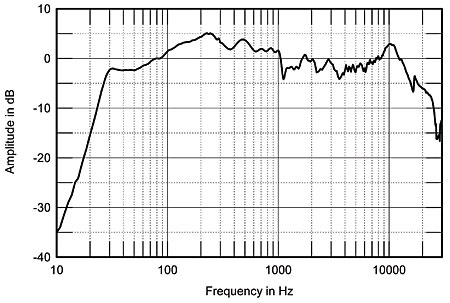
    Wow, that's pretty knarly. That's a qasi-anechoic graph?....OY! With that large peak at 200Hz (very similar to a BOSE cube), and with a deep suck out after 1kHz, and some pretty mean hashiness between 1kHz and 4kHz, idiosyncratic is a very kind way of calling it!
    Audio;
    Ming Da MC34-AB 75wpc
    PS Audio Classic 250. 500wpc into 4 ohms.
    PS Audio 4.5 preamp,
    Marantz 6170 TT Shure M97e cart.
    Arcam Alpha 9 CD.- 24 bit dCS Ring DAC.
    Magnepan 3.6r speakers Oak/black,

  13. #138
    RGA
    RGA is offline
    Forum Regular
    Join Date
    Nov 2003
    Posts
    5,539
    The thing is I am accused of not understanding measurements - it is clear that most of you do not. A frequency response graph measured at a given SPL say 90db - on the left. This graph measures frequency and decibel level at those frequencies. At 200hz the speaker is +5db and 1khz the speaker shows a -4db dip which is not all that bad and rather common for two way loudspeakers. JA notes that despite the 1khz dip "What's interesting about this graph is that it suggests, at least in a room of small to medium size, that the discontinuities in the speaker's on-axis response will, to some extent, be compensated for by its off-axis behavior. The dispersion has a flare just above 1kHz, where the on-axis response has that step down. Similarly, the slight off-axis flare in the octave at the base of the tweeter's passband coincides with a slight lack of on-axis energy"

    The speaker is to be corner loaded with a fair amount of toe in - it is meant to be positioned therefore "off axis" and it would have been nice if it was measured in the location the speaker is meant to be placed and "positioned" properly in that location. AN measures the speakers at common listening positions and is going for a neutral balance at the listening chair. I see the speaker measuring better off-axis and coupled with the on axis measurements factoring in floor bounce, side and back wall parameters the midrange will yield quite a solid neutral balance - certainly does to the ear - though yes it does step down but that is preferable to the opposite.

    At 10khz there is a +2.5db rise. None of this is particularly out of kilter with Colloms measurements that indicated 28hz - 20khz +/- 3db. In room the speaker is off Colloms marks by 2db but then it was not corner loaded. The speaker indicates a -6db point at 20khz and perhaps -7db point at 23khz (hard to say without seeing the next line) I read from this graph that the tuning port is about 28-29hz a -5db point at about 26-27hz and 23-24hz at -10db - the speakers was not measured in corners which add a significant boost so Colloms and AN" published specs on bass and treble seem more fairly reasonable.

    "A loudspeaker placed in a corner can gain up to 18dB in SPL at very low frequencies with perfectly rigid walls." The AN E measurements don't need those 18db in fact to get 18hz - 6db they only need 14db. The graph clearly shows a 17hz to 18hz point at -20db. It is clear that Colloms and AN's 18hz - 6db point corner loaded is perfectly reasonable from the set of measurements provided. Moreover the measurements conducted by hi-Fi Choice noted that the presence band was about 2db higher than rest of the treble band which is fair to say. thanks I know how to read the fricking graph - obviously some people here need a refresher. I am surprised that JA says " I'm not surprised that Audio Note recommends placement close to the wall behind it" and then did not do the measurements from the corner - he was obviously told how the speaker should be placed and then wonders why the speaker didn't meet spec. WTF? I know he doesn't like Peter - but you really should send an e-mail and ask a question or two before making assumptions.
    Last edited by RGA; 07-27-2010 at 09:49 AM.

  14. #139
    It's just a hobby
    Join Date
    Oct 2004
    Location
    London, UK
    Posts
    808
    Quote Originally Posted by Geoffcin
    Wow, that's pretty knarly. That's a quasi-anechoic graph?....OY! With that large peak at 200Hz (very similar to a BOSE cube), and with a deep suck out after 1kHz, and some pretty mean hashiness between 1kHz and 4kHz, idiosyncratic is a very kind way of calling it!
    Well, it's quasi-anechoic up till 300Hz, below that JA used the nearfield technique to measured the bass in 2pi space. So the peak at 200Hz is a bit exaggerated, but the various idiosyncracies between 1- 10kHz are real.
    It's a listening test, you do not need to see it to listen to it!

  15. #140
    Silence of the spam Site Moderator Geoffcin's Avatar
    Join Date
    May 2003
    Location
    NY
    Posts
    3,326
    There's a lot that this graph doesn't show but what it does I understand quite well.


    it's pretty clear that a smooth response is NOT what this designer is after. In addition the designer has buit in what appears to be a "loudness" curve with hinges at 200Hz and 10kHz. That kind of "cheating" in design was common 30 years ago, but lately manufacturers of quality modern speakers strive for a flatter response.
    Audio;
    Ming Da MC34-AB 75wpc
    PS Audio Classic 250. 500wpc into 4 ohms.
    PS Audio 4.5 preamp,
    Marantz 6170 TT Shure M97e cart.
    Arcam Alpha 9 CD.- 24 bit dCS Ring DAC.
    Magnepan 3.6r speakers Oak/black,

  16. #141
    RGA
    RGA is offline
    Forum Regular
    Join Date
    Nov 2003
    Posts
    5,539
    So you believe a flatter response such as this is ideal?As you can see there is a 2.5db boost in the 100hz region, a -2.5db drop at 300hz and a little more at 800hz with a 2.5db spike at 900hz and then dropping again between 1kz and 2khz a significant spike at 9-10khz and a rise which with good HF hearing will may well be viewed as a bright sounding loudspeaker. I find this speaker to be treble heavy (not ridiculously so and i have seen worse - but this is considered to be a "good" measuring loudspeaker - good for the industry because consumers will keep the upgrade mill going and people will keep reading the magazines after they want to trade these bright boys in) - for me it would be fatigue inducing over long listening sessions.
    Attached Images Attached Images  
    Last edited by RGA; 07-27-2010 at 10:08 AM.

  17. #142
    Silence of the spam Site Moderator Geoffcin's Avatar
    Join Date
    May 2003
    Location
    NY
    Posts
    3,326
    This graph has half the divergence that the previous one did. +/- 2.5dB over a good portion of it's range. The smooth hump at 100Hz is much more acceptable than a high peak at 220Hz.
    Audio;
    Ming Da MC34-AB 75wpc
    PS Audio Classic 250. 500wpc into 4 ohms.
    PS Audio 4.5 preamp,
    Marantz 6170 TT Shure M97e cart.
    Arcam Alpha 9 CD.- 24 bit dCS Ring DAC.
    Magnepan 3.6r speakers Oak/black,

  18. #143
    RGA
    RGA is offline
    Forum Regular
    Join Date
    Nov 2003
    Posts
    5,539
    The corner loading will bring that down - Stereophile noted that the peak was 2db higher than it would be anyway. The AN E is has an elevation then of around 2db without the boost JA noted which is not all that bothersome - not as bothersome as a speaker that clearly has a shelved up treble band. The corner loading will add spl to the low bass - not the midbass and thus the entire bass frequency band would be considerably flatter assuming they position it properly. I have seen the measurements done by Audiophile in Germany and it indicates that. Though both graphs and Hi-Fi Choice do note that the AN E's presnce band is a couple db higher than the treble band - my contention is that having a few db emphasis in that region is a LOT LOT LOT better than having any slight emphasis in the treble band. With partnering amplification that has a weaker output in the bass (SET) can offset the gain in the bass region - since it is designed to work with specific amplification. This alters the speaker's output.

  19. #144
    M.P.S.E /AES/SMPTE member Sir Terrence the Terrible's Avatar
    Join Date
    Jul 2002
    Posts
    6,826
    Quote Originally Posted by RGA
    The thing is I am accused of not understanding measurements - it is clear that most of you do not. A frequency response graph measured at a given SPL say 90db - on the left. This graph measures frequency and decibel level at those frequencies. At 200hz the speaker is +5db and 1khz the speaker shows a -4db dip which is not all that bad and rather common for two way loudspeakers. .
    Rich, personally(and I am only speaking for myself) I have an extremely clear understanding of how to read a speakers frequency measurements. With a minor degree in acoustical analysis and a ton of experience in HT and audio setups with an emphasis on room acoustics, speaker setup, and balancing, reading them was an everyday part of my life.

    I have three two way mini monitor system that do not have this kind of response deviation between 200-1khz. Your explaination of a 5db peak at 200hz, and a 4db dip 1khz represents a frequency response of +-9db between 200-1khz. That quite frankly is a horrible measurement by any sane person's standard. Two of my mini monitor systems(the same speakers in different rooms) over that same range have a .5db deviation, and the other is 1.5db deviation. This is an in room measurement without the benefit of EQ.

    This speaker based on those measurements is going to have a rich, overly ripe mid bass character, and with a recess of 4db at 1khz, and a recovered response at 4k will cause instruments whose fundamentals lie in those frequencies to pop in out of the mix randomly. Having a 4db deviance in the critical 1-4khz area is just poor speaker voicing, I don't care who designed the speaker.
    Sir Terrence

    Titan Reference 3D 1080p projector
    200" SI Black Diamond II screen
    Oppo BDP-103D
    Datastat RS20I audio/video processor 12.4 audio setup
    9 Onkyo M-5099 power amp
    9 Onkyo M-510 power amp
    9 Onkyo M-508 power amp
    6 custom CAL amps for subs
    3 custom 3 way horn DSP hybrid monitors
    18 custom 3 way horn DSP hybrid surround/ceiling speakers
    2 custom 15" sealed FFEC servo subs
    4 custom 15" H-PAS FFEC servo subs
    THX Style Baffle wall

  20. #145
    Silence of the spam Site Moderator Geoffcin's Avatar
    Join Date
    May 2003
    Location
    NY
    Posts
    3,326
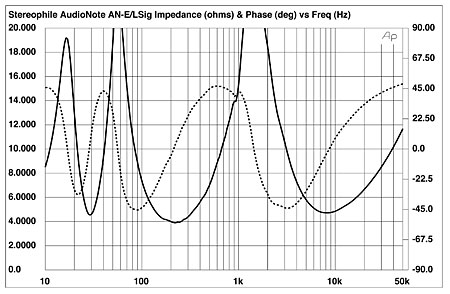
    You might think so, but with an impedance chart like this;

    Who can tell what kind of interaction with a high output impedance tube amp will be. You might have +/-10dB or more!!
    Audio;
    Ming Da MC34-AB 75wpc
    PS Audio Classic 250. 500wpc into 4 ohms.
    PS Audio 4.5 preamp,
    Marantz 6170 TT Shure M97e cart.
    Arcam Alpha 9 CD.- 24 bit dCS Ring DAC.
    Magnepan 3.6r speakers Oak/black,

  21. #146
    It's just a hobby
    Join Date
    Oct 2004
    Location
    London, UK
    Posts
    808

    Lightbulb Once again, take into account measurement artifacts

    Quote Originally Posted by RGA
    So you believe a flatter response such as this is ideal?As you can see there is a 2.5db boost in the 100hz region, a -2.5db drop at 300hz and a little more at 800hz with a 2.5db spike at 900hz and then dropping again between 1kz and 2khz a significant spike at 9-10khz and a rise which with good HF hearing will may well be viewed as a bright sounding loudspeaker. I find this speaker to be treble heavy (not ridiculously so and i have seen worse - but this is considered to be a "good" measuring loudspeaker - good for the industry because consumers will keep the upgrade mill going and people will keep reading the magazines after they want to trade these bright boys in) - for me it would be fatigue inducing over long listening sessions.
    This speaker is essentially flat below 300Hz, the 2.5dB boost at 100Hz in the graph is a measurement artifact.
    It's a listening test, you do not need to see it to listen to it!

  22. #147
    RGA
    RGA is offline
    Forum Regular
    Join Date
    Nov 2003
    Posts
    5,539
    Quote Originally Posted by Sir Terrence the Terrible
    Rich, personally(and I am only speaking for myself) I have an extremely clear understanding of how to read a speakers frequency measurements. With a minor degree in acoustical analysis and a ton of experience in HT and audio setups with an emphasis on room acoustics, speaker setup, and balancing, reading them was an everyday part of my life.

    I have three two way mini monitor system that do not have this kind of response deviation between 200-1khz. Your explaination of a 5db peak at 200hz, and a 4db dip 1khz represents a frequency response of +-9db between 200-1khz. That quite frankly is a horrible measurement by any sane person's standard. Two of my mini monitor systems(the same speakers in different rooms) over that same range have a .5db deviation, and the other is 1.5db deviation. This is an in room measurement without the benefit of EQ.

    This speaker based on those measurements is going to have a rich, overly ripe mid bass character, and with a recess of 4db at 1khz, and a recovered response at 4k will cause instruments whose fundamentals lie in those frequencies to pop in out of the mix randomly. Having a 4db deviance in the critical 1-4khz area is just poor speaker voicing, I don't care who designed the speaker.
    The problem for you is that the speaker is plus 4.5db at 200hz when JA claims that that is at least 2db too high - cut that down to 3-3.5db. He also notes that the off axis response which is cleaner and the way the speaker is supposed to be audition provides a boost in the 1khz region. That 9db differential is closer to a 3db differential and alternate measurements show it - Stereophile's does not but then they didn't measure the speaker where it is suppsoed to be measured. A 2.5db - 3.5db differential is hardly anything to write home about.

    Personally I would rather you discuss the measurement techniques with the manufacturer and get their measurements when the speaker is positioned correctly and toed in correctly and then see the results. A corner loaded speaker that takes the corner and the floor distance into account and is meant to be at a specific height to be then measured indipendandtly in the middle of a room on a stand that was over a foot higher than it's supposed to be on axis (when it is supposed to be toed in dramatically) seems incomprehensible to me.

    Ask the question on AA as Peter posts there a fair bit. http://db.audioasylum.com/cgi/m.mpl?...measurement&r=
    Last edited by RGA; 07-27-2010 at 12:14 PM.

  23. #148
    RGA
    RGA is offline
    Forum Regular
    Join Date
    Nov 2003
    Posts
    5,539
    Quote Originally Posted by theaudiohobby
    This speaker is essentially flat below 300Hz, the 2.5dB boost at 100Hz in the graph is a measurement artifact.
    Yes and he noted that for the AN E as well and I am happy that you also noted this. Unfortunately that also means that ear will further locate the treble band in the graph I posted - the ear will not the stronger band and in the second graph without much bass midbass or upper bass and with prominant rises in the mid and upper treble the ear will be drawn to that and it will generate fatigue. Speakers that have a general rising altitude in db as frequency rises are bright leaning loudspeakers that generally cause fatigue IME. I have no problem if people say the AN E has a lifted presence band - it does and it sounds like it.

    Art Dudley notes that it is "stronger in the left hand on piano" and that's fair criticism because it does - the body of the piano sounds richer fuller and has a bigger bodied sound than the speaker graph I posted that comparatively doesn't sound full bodied or like a real piano is sitting in the room. Hi-Fi Choice noted the presence band being 2db higher and thus it would clearly have a slight 2-3db lift in the left hand of piano or other bass instruments. Nothing is perfect but I want the speaker to sound more like a piano is in the room and compared directly against a Piano in the same room the AN E sounds more like it than does the speaker with the graph I posted. Art felt the same way, as did Wes Philips as did Peter Van Willenswaard all from Stereophile. I think we would both at least agree that speaker designer elected to go with his ear over the textbook measurements (whether one views that as a good or bad thing will depend on the subjective response of the listener and I respect that some won't want that).

    I don't have a problem with a speaker that has a slight emphasis in the presence band - I prefer it to a presence in the treble band. It offers a fuller bodied sound - similar I would suggest to the Harbeth and Tannoy prestige schools. Although I find the Harbeth to sound a little "thicker" or warmer in nature they were fine speakers at CES that were quite easy to listen to without sounding thin and gritty.

    I would also suggest that as a result of a speaker that has a slight presence band lift and that is not tripped up on the treble will perform better in low level listening sessions without the need to be played "louder" to get the sense of bass response. For late night apartment owners this can be a God send. Moreover, it works at the other end of the volume spectrum - at louder listening levels the the treble will not overpower the senses. Looking at the way the ear gels with the Munson effect you will have an easier time of it at loud levels - can listen far longer (whcih could be dangerous) but nevertheless it won't be abnoxious. The AN E can play without compression to quite stupid levels with a big helping of bass response without sounding shrill. All of this may not be positives in the "accuracy" debate but they are certainly positives in the end user listening esperience camp.

    Granted I know you disagree on this next point but what I found enitirely frustrating with the B&W 705 with an all bryston front end in a smallish room was that I had to keep turning the volume up to get a sense of midbass drive and "room filling" presence. I did not get the volume up that high and the bass became steadily lesser and lesser as if the louder I put it the 'thinner" it got. I find this true of "every" single standmount on the market that I have heard of similar size and shape and driver size compliment. At low volume there is very little bass or midbass. It's disastrous on music like Lady Gaga. Take a song like Bad Romance - it should have a BIG badass bass drive and room filling scale. You should be able to CRANK that sucker up and get hit you in the chest bass speed and articulation. What you get is a completely anaemic presentation compared to the AN E of Harbeth 40.1. I tried a couple of subs that added the presence in the lower bass but not in the mid upper bass and the treble is still tripped up.

    That big bold sound on music like pop/trance/rap/metal/rock can't be ignored because the speaker happens to have a 2db "further dip" in the band that is playing a violin. The graph of the speaker I posted has a 2db less dip at 1khz). To me the trade-off is just not one worth making. And I bet most people who listen to the AN E will not make the trade-off either - which explains why despite the foibles the other stuff it brings to the table is more desirable - and why guys like Wes Philips who loves those 6 inch wooferx slimmer than wider and "better measuring" speakers was brought to tears by the AN E. Despite what people like to think, the presence band tends to push the emotional buttons regardless of the music playing - that bass richness has something to it. The ear will adjust to frequency anomolies within a few minutes.
    Last edited by RGA; 07-27-2010 at 12:48 PM.

  24. #149
    RGA
    RGA is offline
    Forum Regular
    Join Date
    Nov 2003
    Posts
    5,539
    Sir T. To go along with the measurements look at the two AN E results. The black graph is the mid room on stands far too high. You see what I see a pretty flat response from 300hz to 1khz and then the nosedive from 1khz to 1.1khz, but as you can see in the in room off axis response how it would normally be positioned (though Art still doesn't have them hard in corners or towed in enough IMO, the blue curve has now flattened out significantly - the nosedive that looked like 6db in the first graph is now about 1db from 1khz to 1.1khz - the step down from that point on is also far smoother. There is a dip higher up at 1.6khz which is about +2.5db and then dips to -2db at 2.3khz but this is a much slower and steadier drop off than the first graph. I suspect there are some in room issues because the same thing is happening to Harbeths in the same region.

    Audio Note's crossover is located above 2khz (2.3khz) and seems about right here. The behaviour below 300hz seems room related again because both speakers are showing similar anomolies in the 100hz-200hz region - I would like to see some different speakers in the same room because the first graphs actually shows the AN E has a rise between 100hz and 300hz. In Art's room it shows a significant dip in that region. It can't be both. Clearly the measurements are illustrating some room related issues but I can't be sure because the initial black graph measurement was not tested in a corner position the way it should have been so the baseline is corrupt. Art's room would convince me more if the Harbeth wasn't showing such similar results in numerous parts of the band and very dissimilar results to the black graph version.
    Attached Images Attached Images    
    Last edited by RGA; 07-27-2010 at 01:27 PM.

  25. #150
    RGA
    RGA is offline
    Forum Regular
    Join Date
    Nov 2003
    Posts
    5,539
    I think I raise a valid point. On the black graph the speaker shows a rise in the 100hz - 300hz region and in Art's room it looks like a suckout in the same band. The 800hz-2khz region looks a lot better in Art's room than the initial on axis response.

    And maggies measure terrible - no evidence from anyone here has remotely said otherwise except for a lame exuces that diploles are tough to measure.

    I'd be happy to pit the AN E against the 3.6 in a blind level matched sessions with say 20-30 trained jazz/classical musicians. Or any Toole inspired standmount. Are you game. It would be a preference based test. Two identical rooms, stereos are black lit out, same music level matched. Each listner listens to both rooms - each has a card and places the card for the room they liked best in a box. I would be willing to stack the deck in your favour - any SS front end at any price. I get an OTO and a one box cd player. You get to use treatments and an EQ if you wish. Say a few days to get it all organized. I get no treatments, no EQ, and no more than 3 hours to set-up. I would bet that no less than 80% of listeners choose the AN room. Might be fun. I have all of August and you can choose whichever hotel room is in this area. All that I require is corners.

    Edit: Not sure the music program is going in August. I'll have to check. Might have to conduct the test at the university. I can check into it if you wish. Have had the idea for such preference testing for awhile but the logistics need to be worked out. I can probably borrow most of the gear so that should not be an issue - so no need to transport 3.6 speakers around. Soundhounds has done blind tests as well but I would rather impartial locality

Page 6 of 17 FirstFirst ... 4 5 6 7 8 16 ... LastLast

Thread Information

Users Browsing this Thread

There are currently 1 users browsing this thread. (0 members and 1 guests)

Posting Permissions

  • You may not post new threads
  • You may not post replies
  • You may not post attachments
  • You may not edit your posts
  •