Results 1 to 25 of 96

Hybrid View

  1. #1
    M.P.S.E /AES/SMPTE member Sir Terrence the Terrible's Avatar
    Join Date
    Jul 2002
    Posts
    6,826
    Recording practice leaves a lot to be desired. Few or no recording engineers will take the time or spend the money to make really capture the sound of a fine concert hall. Most use many microphones close to the instruments and "fix it in the mix". Sir Terrence as assured us that it excellent results can be achieved with close microphoning and I believe him that they can because I have many excellent recordings made that way. Unfortunately there are many, many recordings, (old and new; CD and LP), that have a raunchy quality of sound that you will never hear from a good seat in a good concert hall.
    Feanor,
    The mentality "fix it in the mix" has not existed at least among live recording engineers for over a decade. The studio is a different story since it is already a manufactured environment.

    In saying that, for various reasons whether equipment or musician based we have to go back to the studio and edit in or out something. This is why I always put out more microphones than I really need when I record live. I had an instance where I had to "fix it in the mix" because a clarinet player squeaked at the beginning of his solo. I had a spotlight microphone to capture it because the orchestra was quite large, and there were other instruments playing at the same time. Since this was a live performance, we could not stop and do it over. When I returned to my studio to tweak the mix(some light balancing of certain passages to flush them out) I could not shut that microphone off as we mixed live to 5.1 on the spot. So I took the solo off a practice run(which was flawless), edited out the squeak, and replaced it with the flawless take from that practice run. The Clarinet player was shocked because he knew he squeaked, but heard nothing but a flawless solo. I don't really like to do this kind of thing, but sometimes you have to do what you have to do to get things right.

    When you are messing around with dwindling recording budgets like we are now days, you have to always have some sort of back up just in case something goes wrong. Since I mostly do live recordings, there is often no oportunity to re-record anything in case a mistake has happened.

    So you understand, every recording engineer I know goes into a project wanting to capture the best sound he or she can. However, as some stage the project is out of our hands, and into the marketing departments. It is there were the most damaging decision in regard to the audio are made. The loudness war was created by the marketing departments in studios, not by the mastering engineer themselves. The record company has the last word on ANY recordings made on their label. The only way to end this whole loudness thing was to just not do any project where the marketing department has the last word. I refuse to do any mastering that required uber amounts of compression on a recording already recorded too hot. A lot of mastering engineers have done the same thing.
    Sir Terrence

    Titan Reference 3D 1080p projector
    200" SI Black Diamond II screen
    Oppo BDP-103D
    Datastat RS20I audio/video processor 12.4 audio setup
    9 Onkyo M-5099 power amp
    9 Onkyo M-510 power amp
    9 Onkyo M-508 power amp
    6 custom CAL amps for subs
    3 custom 3 way horn DSP hybrid monitors
    18 custom 3 way horn DSP hybrid surround/ceiling speakers
    2 custom 15" sealed FFEC servo subs
    4 custom 15" H-PAS FFEC servo subs
    THX Style Baffle wall

  2. #2
    Shostakovich fan Feanor's Avatar
    Join Date
    Jun 2002
    Location
    London, Ontario
    Posts
    8,127
    Quote Originally Posted by Sir Terrence the Terrible View Post
    Feanor,
    The mentality "fix it in the mix" has not existed at least among live recording engineers for over a decade. The studio is a different story since it is already a manufactured environment.
    ....
    Well, I'll take your word for that, Sir T.

    Since I'm almost entirely a classical listener, problems with extreme compression aren't the usual problem.

    "Harsh" sound however is all too common, even typical for classical music problems. Skreechy violins and other strings is the biggest aggravation. Next I'd say is too much brightness or imbalance towards the high end of the spectrum. Thirdly -- and exaggerating the first two issues -- too many records have very close-up perspective, performer rather than concert goer. To be sure, perspective is partially personal preference.

    If I loved tubes and vinyl, I guess I'd blame s/s and CD for these problems. However what I see is that some recordings sound great: violins timbres are captured but the sound isn't gratuitously skreechy, therefore I tend to blame the recordings, not the play-back equipment.

  3. #3
    M.P.S.E /AES/SMPTE member Sir Terrence the Terrible's Avatar
    Join Date
    Jul 2002
    Posts
    6,826
    Quote Originally Posted by Feanor View Post
    Well, I'll take your word for that, Sir T.

    Since I'm almost entirely a classical listener, problems with extreme compression aren't the usual problem.

    "Harsh" sound however is all too common, even typical for classical music problems. Skreechy violins and other strings is the biggest aggravation. Next I'd say is too much brightness or imbalance towards the high end of the spectrum. Thirdly -- and exaggerating the first two issues -- too many records have very close-up perspective, performer rather than concert goer. To be sure, perspective is partially personal preference.

    If I loved tubes and vinyl, I guess I'd blame s/s and CD for these problems. However what I see is that some recordings sound great: violins timbres are captured but the sound isn't gratuitously skreechy, therefore I tend to blame the recordings, not the play-back equipment.
    Feanor,
    In my opinion Redbook CD is not very friendly to acoustic music. Also there is occasionally a poor choice of microphones picks for recording. The problem with RBCD is two fold. If you try and record with a "audience" perspective, instruments in the rear of the orchestra lose their precision. It becomes much more difficult to balance the orchestra, and you have to use some equalization to sharpen up that imprecise sound, hence the hardness that can crop up. I would have to say 16/44.1khz is not enough resolution to do acoustical music in a large venue. It is much better for rock, gospel, and other genre's were you can go direct to the mixing board, eschewing any use of a microphones for recording.

    Just as an example; critically listen to the SACD of Jack Renner's 1812 Overture. Then listen to the CD layer of that same recording. If you listen carefully, you will find that the overall presentation of the CD is quite a bit more diffused than the SACD. This is the problem with Renner's microphone technique and the RBCD format.

    In saying all of this, there are sometimes just poor recordings made, and that is a fact.
    Sir Terrence

    Titan Reference 3D 1080p projector
    200" SI Black Diamond II screen
    Oppo BDP-103D
    Datastat RS20I audio/video processor 12.4 audio setup
    9 Onkyo M-5099 power amp
    9 Onkyo M-510 power amp
    9 Onkyo M-508 power amp
    6 custom CAL amps for subs
    3 custom 3 way horn DSP hybrid monitors
    18 custom 3 way horn DSP hybrid surround/ceiling speakers
    2 custom 15" sealed FFEC servo subs
    4 custom 15" H-PAS FFEC servo subs
    THX Style Baffle wall

  4. #4
    Music Junkie E-Stat's Avatar
    Join Date
    Dec 2003
    Posts
    5,462
    Quote Originally Posted by Sir Terrence the Terrible View Post
    Just as an example; critically listen to the SACD of Jack Renner's 1812 Overture. Then listen to the CD layer of that same recording. If you listen carefully, you will find that the overall presentation of the CD is quite a bit more diffused than the SACD. This is the problem with Renner's microphone technique and the RBCD format.
    You're comparing apples and oranges. That is true when a MC recording is remixed later for stereo as is the case here. Let's listen to Robert Woods describe the differences in the liner notes for that recording.

    "Over the years, our usual microphone setup for an orchestra has consisted of three or four space omnidirectional microphones across the front of the orchestra. The surround recording, however, requires a different approach: directional microphones for the front channels, outside and mid-hall microphones to help wrap the orchestra in a gentle arc in front of the listener, plus ambience pickup microphones that are arranged to mid and rear channels. I employed the Neumann binaural head microphone as a critical part of the surround pickup."

    This "multi-channel from the start" recording was thus recorded quite differently than they would have done for a stereo recording.

    That reality doesn't retract from the multi-channel result - it only renders comparisons to the derived stereo remix invalid to draw any conclusions.

  5. #5
    Shostakovich fan Feanor's Avatar
    Join Date
    Jun 2002
    Location
    London, Ontario
    Posts
    8,127
    Quote Originally Posted by Sir Terrence the Terrible View Post
    Feanor,
    In my opinion Redbook CD is not very friendly to acoustic music. Also there is occasionally a poor choice of microphones picks for recording. The problem with RBCD is two fold. If you try and record with a "audience" perspective, instruments in the rear of the orchestra lose their precision. It becomes much more difficult to balance the orchestra, and you have to use some equalization to sharpen up that imprecise sound, hence the hardness that can crop up. I would have to say 16/44.1khz is not enough resolution to do acoustical music in a large venue. It is much better for rock, gospel, and other genre's were you can go direct to the mixing board, eschewing any use of a microphones for recording.

    Just as an example; critically listen to the SACD of Jack Renner's 1812 Overture. Then listen to the CD layer of that same recording. If you listen carefully, you will find that the overall presentation of the CD is quite a bit more diffused than the SACD. This is the problem with Renner's microphone technique and the RBCD format.

    In saying all of this, there are sometimes just poor recordings made, and that is a fact.
    All this said, there are still some very good RBCD recordings.

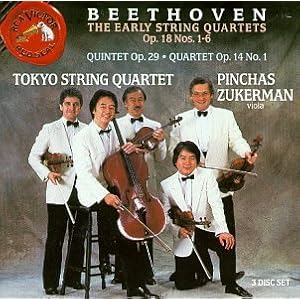
    An example I was listening to a couple of days ago is the Tokyo String Quartet's version of Beethoven's Early Quartets: very good instrument timbres, good ambience, and good perspective.


    Their version of the Middle Quartets has the same very good quality. From what I've heard, no doubt a Hi-rez version would be even better, but still the point remains that RBCD can sound good and doesn't necessarily sound suffer from harshness or "digititis" as vinyl lovers declare.

  6. #6
    M.P.S.E /AES/SMPTE member Sir Terrence the Terrible's Avatar
    Join Date
    Jul 2002
    Posts
    6,826
    Quote Originally Posted by Feanor View Post
    All this said, there are still some very good RBCD recordings.

    An example I was listening to a couple of days ago is the Tokyo String Quartet's version of Beethoven's Early Quartets: very good instrument timbres, good ambience, and good perspective.


    Their version of the Middle Quartets has the same very good quality. From what I've heard, no doubt a Hi-rez version would be even better, but still the point remains that RBCD can sound good and doesn't necessarily sound suffer from harshness or "digititis" as vinyl lovers declare.
    I agree with ya. Do you see the size of that group? Small ensemble that does not necessarily challenge a recording system or format. I can create a GREAT RBCD with a group that small.
    Sir Terrence

    Titan Reference 3D 1080p projector
    200" SI Black Diamond II screen
    Oppo BDP-103D
    Datastat RS20I audio/video processor 12.4 audio setup
    9 Onkyo M-5099 power amp
    9 Onkyo M-510 power amp
    9 Onkyo M-508 power amp
    6 custom CAL amps for subs
    3 custom 3 way horn DSP hybrid monitors
    18 custom 3 way horn DSP hybrid surround/ceiling speakers
    2 custom 15" sealed FFEC servo subs
    4 custom 15" H-PAS FFEC servo subs
    THX Style Baffle wall

  7. #7
    Shostakovich fan Feanor's Avatar
    Join Date
    Jun 2002
    Location
    London, Ontario
    Posts
    8,127
    Quote Originally Posted by Sir Terrence the Terrible View Post
    I agree with ya. Do you see the size of that group? Small ensemble that does not necessarily challenge a recording system or format. I can create a GREAT RBCD with a group that small.
    I'm confident you could!!

    But I give you personal credit. What I'd really like to know why so many string quartet recordings sound like crap.

    Not necessarily the worst example but pretty bad is this recording of Beethoven's Op. 130 quartet and Op. 133, Grosse Fuge by The Lindsays. (I have the hybrid SACD version; unfortunately my SACD player is capable of extracting any more resolution than my DAC is from the CD layer.) The problems here are screechy violins and a 'way too close perspective. If I were a performer I might like to sit among musicians but I prefer a 4th row seat for chamber music.


    I must say, though, that my current DAC and amp are the most transparent I've owned and this recording sounds less bad than it did on some previous equipment. This is a matter of less grunge, not the caramel coating applied by some tube equipment.

  8. #8
    M.P.S.E /AES/SMPTE member Sir Terrence the Terrible's Avatar
    Join Date
    Jul 2002
    Posts
    6,826
    Quote Originally Posted by Feanor View Post
    I'm confident you could!!

    But I give you personal credit. What I'd really like to know why so many string quartet recordings sound like crap.

    Not necessarily the worst example but pretty bad is this recording of Beethoven's Op. 130 quartet and Op. 133, Grosse Fuge by The Lindsays. (I have the hybrid SACD version; unfortunately my SACD player is capable of extracting any more resolution than my DAC is from the CD layer.) The problems here are screechy violins and a 'way too close perspective. If I were a performer I might like to sit among musicians but I prefer a 4th row seat for chamber music.


    I must say, though, that my current DAC and amp are the most transparent I've owned and this recording sounds less bad than it did on some previous equipment. This is a matter of less grunge, not the caramel coating applied by some tube equipment.
    I am willing to bet is just plain poor microphone position combined poor microphone choice. It could also be low quality converters in the signal chain.
    Sir Terrence

    Titan Reference 3D 1080p projector
    200" SI Black Diamond II screen
    Oppo BDP-103D
    Datastat RS20I audio/video processor 12.4 audio setup
    9 Onkyo M-5099 power amp
    9 Onkyo M-510 power amp
    9 Onkyo M-508 power amp
    6 custom CAL amps for subs
    3 custom 3 way horn DSP hybrid monitors
    18 custom 3 way horn DSP hybrid surround/ceiling speakers
    2 custom 15" sealed FFEC servo subs
    4 custom 15" H-PAS FFEC servo subs
    THX Style Baffle wall

Thread Information

Users Browsing this Thread

There are currently 1 users browsing this thread. (0 members and 1 guests)

Posting Permissions

  • You may not post new threads
  • You may not post replies
  • You may not post attachments
  • You may not edit your posts
  •