Results 1 to 25 of 31

Hybrid View

  1. #1
    Loving This kexodusc's Avatar
    Join Date
    Nov 2003
    Location
    Department of Heuristics and Research on Material Applications
    Posts
    9,025
    Quote Originally Posted by Sir Terrence the Terrible
    What he is stating is that two drivers playing the same information will have the same interference pattern as two spaced speakers playing the same information. In order to deal with the drivers interference pattern, you have to gradually roll off the output of one of the drivers as the frequency goes up, or the speaker will measure poorly, and will have intelligibility issues with dialog. These are called 2.5 way speakers, as opposed to two way speakers where both woofers handle the same range of frequencies.
    Oh ok he's talking screw up acoustically, not electrically...and really the drivers aren't screwing each other up...the sound waves are.

    Just to play devils advocate here though, been a few years since I took physics but isn't the audible effects of the interference pattern directly related to where you are physically positioned relative to the drivers(s), and how far apart the acoustic centers of the speakers/drivers are?...and in real life, how audible is this going to be in a typical room, several feet back, even if the spacing between the speakers is going to be a few feet? It would seem to me the further back you are the less relevant it becomes?

    Why isn't interference pattern an issue for stereo imaging (centered vocals etc?)...or maybe it is and it's just a given stereo will never be perfect?

  2. #2
    Forum Regular Kevio's Avatar
    Join Date
    Dec 2008
    Location
    Colorado
    Posts
    452
    The interference occurs when one of the drivers is closer to you than the other. In this situation, due to the limited speed of sound, you get two copies of the same sound arriving at your ear at slightly different times. The delay translates into a phase difference and the two copies partially cancel each other out resulting in what we typically perceive as timbre change. The technical name for the phenomenon is a comb filter. But keep in mind that none of this happens when the distance to the two drivers is approximately equal as is the case for most of these ear height tower speakers.

    It certainly is an issue in stereo playback - that's why we have a listening sweet spot (were the distance from our ears to each speaker is the same).

    Also recognize that this comb filtering happens in our natural environments as sound bounces off walls and reaches our ears through multiple paths. Along with reverberation, It is part of what gives our hearing a sense of space. So as with 2nd harmonic distortion, a comb filter scenario can add to and enhance our enjoyment of recorded music.

  3. #3
    Loving This kexodusc's Avatar
    Join Date
    Nov 2003
    Location
    Department of Heuristics and Research on Material Applications
    Posts
    9,025
    Quote Originally Posted by Kevio
    The interference occurs when one of the drivers is closer to you than the other. In this situation, due to the limited speed of sound, you get two copies of the same sound arriving at your ear at slightly different times. The delay translates into a phase difference and the two copies partially cancel each other out resulting in what we typically perceive as timbre change. The technical name for the phenomenon is a comb filter. But keep in mind that none of this happens when the distance to the two drivers is approximately equal as is the case for most of these ear height tower speakers.

    It certainly is an issue in stereo playback - that's why we have a listening sweet spot (were the distance from our ears to each speaker is the same).

    Also recognize that this comb filtering happens in our natural environments as sound bounces off walls and reaches our ears through multiple paths. Along with reverberation, It is part of what gives our hearing a sense of space. So as with 2nd harmonic distortion, a comb filter scenario can add to and enhance our enjoyment of recorded music.
    I'm well aware of comb filtering - in the dual center channel example, the acoustic centers of the two speakers in question is what I'm wondering about - while we may measure some artifacts, how bad is it really going to be at the listening position, and would other perceived benefits of such an arrangement offset the negatives? If you're head is "in between" the axis of each speaker? Vertical dispersion in this setup is going to be fairly poor, but you're not likely to drift higher or lower than either speaker. Your post even hinted at it - "when the distance to the two drivers is approximately equal". While not measuring perfectly equal at the listening position, in light of all the other interference and distortion sound picks up between the time it leaves the speaker and the time it hits your ears, I would contend the interference effects in the dual center arrangement are tolerable, and overall not that significant. (But still easy to avoid if you buy a ONE good center channel, which would of course be preferable).


    I know in speaker building, we try to keep the acoustic centers as close as possible, less than a wavelength of the frequency of the xo as a rule of thumb. The D'Appolito arrangement (woofer, tweeter, woofer) is well documented for its minimal vertical dispersion, but so long as your head is in between the woofers (close to tweeter level, give or take several inches) you're ok. I'm half expecting a similar effect here, just haven't seen any measurements of such a setup.

  4. #4
    Forum Regular Kevio's Avatar
    Join Date
    Dec 2008
    Location
    Colorado
    Posts
    452
    Quote Originally Posted by kexodusc
    Just to play devils advocate here though, been a few years since I took physics but isn't the audible effects of the interference pattern directly related to where you are physically positioned relative to the drivers(s), and how far apart the acoustic centers of the speakers/drivers are?...and in real life, how audible is this going to be in a typical room, several feet back, even if the spacing between the speakers is going to be a few feet? It would seem to me the further back you are the less relevant it becomes?
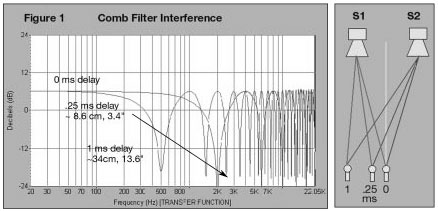
    Here's a mathematical picture that may help you visualize what's going on at different frequencies
    Name:  comb.jpg
Views: 309
Size:  53.2 KB
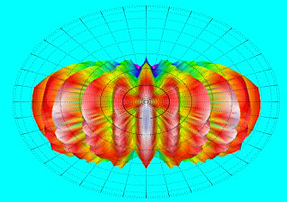
    Here's a pretty picture showing what's happening in three dimensions at a single frequency with two side-by-side drivers. You can cock your head sideways and imagine how drivers stacked vertically behave.
    Name:  lobes.jpg
Views: 255
Size:  104.2 KB

  5. #5
    Loving This kexodusc's Avatar
    Join Date
    Nov 2003
    Location
    Department of Heuristics and Research on Material Applications
    Posts
    9,025
    Quote Originally Posted by Kevio
    Here's a mathematical picture that may help you visualize what's going on at different frequencies
    Name:  comb.jpg
Views: 309
Size:  53.2 KB
    Here's a pretty picture showing what's happening in three dimensions at a single frequency with two side-by-side drivers. You can cock your head sideways and imagine how drivers stacked vertically behave.
    Name:  lobes.jpg
Views: 255
Size:  104.2 KB
    Nice pictures, but they don't tell us how far apart the sources are, or your relative position to each source, which I believe are key variables. I'd be curious to see measurements with two speakers probably 4-6ft apart at 8-10 ft distnace, taken from the sweet spot?

  6. #6
    Forum Regular Kevio's Avatar
    Join Date
    Dec 2008
    Location
    Colorado
    Posts
    452
    Quote Originally Posted by kexodusc
    Nice pictures, but they don't tell us how far apart the sources are, or your relative position to each source, which I believe are key variables. I'd be curious to see measurements with two speakers probably 4-6ft apart at 8-10 ft distnace, taken from the sweet spot?
    Measurements taken at the sweet spot are going to be fine. Comb filtering only occurs for off-center listening positions.

    The first null in the comb filter occurs when the two signals are offset by 1/2 wavelength. At 1 KHz, a wavelength is approximately 1 foot. So you'll get a 1 KHz null if the difference between path length to the two sources is 6 inches. So, for example, if your distance from the sources is 8 feet and the sources are 1 foot apart, trigonometry tells us the null corresponds to a listening angle of 45 degrees off center. If the sources are further apart, your listening position is closer or the frequency of interest is higher, the sensitivity to listening angle will be greater.

  7. #7
    Suspended
    Join Date
    Apr 2004
    Location
    Out there
    Posts
    6,777
    Quote Originally Posted by Kevio
    Here's a mathematical picture that may help you visualize what's going on at different frequencies
    Name:  comb.jpg
Views: 309
Size:  53.2 KB
    Here's a pretty picture showing what's happening in three dimensions at a single frequency with two side-by-side drivers. You can cock your head sideways and imagine how drivers stacked vertically behave.
    Name:  lobes.jpg
Views: 255
Size:  104.2 KB
    Yes, the picture is very pretty. I especially like the many shades of blue that were included.

  8. #8
    Forum Regular pixelthis's Avatar
    Join Date
    Apr 2007
    Location
    tuscaloosa
    Posts
    5,528

    Cool

    Quote Originally Posted by kexodusc
    Oh ok he's talking screw up acoustically, not electrically...and really the drivers aren't screwing each other up...the sound waves are.

    Just to play devils advocate here though, been a few years since I took physics but isn't the audible effects of the interference pattern directly related to where you are physically positioned relative to the drivers(s), and how far apart the acoustic centers of the speakers/drivers are?...and in real life, how audible is this going to be in a typical room, several feet back, even if the spacing between the speakers is going to be a few feet? It would seem to me the further back you are the less relevant it becomes?

    Why isn't interference pattern an issue for stereo imaging (centered vocals etc?)...or maybe it is and it's just a given stereo will never be perfect?

    SIR TALKY GOT IT WRONG, AS USUAL.
    Two centers will work, its a matter of distance, which requires a LARGE screen.
    Stereo works of course because its two different signals.
    Ture they share info, so the father apart the better.
    LG 42", integra 6.9, B&W 602s2, CC6 center, dm305rears, b&w
    sub asw2500
    Panny DVDA player
    sharp Aquos BLU player
    pronto remote, technics antique direct drive TT
    Samsung SACD/DVDA player
    emotiva upa-2 two channel amp

Thread Information

Users Browsing this Thread

There are currently 1 users browsing this thread. (0 members and 1 guests)

Posting Permissions

  • You may not post new threads
  • You may not post replies
  • You may not post attachments
  • You may not edit your posts
  •