Page 2 of 4 FirstFirst 1 2 3 4 LastLast
Results 26 to 50 of 165

Hybrid View

  1. #1
    Phila combat zone JoeE SP9's Avatar
    Join Date
    Jun 2003
    Location
    Philadelphia, PA
    Posts
    2,710
    I was poking around (looking for something else) and found this nice shot of the Finial ELP-1 Laser LPplayer


    ARC SP9 MKIII, VPI HW19, Rega RB300
    Marcof PPA1, Shure, Sumiko, Ortofon carts, Yamaha DVD-S1800
    Behringer UCA222, Emotiva XDA-2, HiFimeDIY
    Accuphase T101, Teac V-7010, Nak ZX-7. LX-5, Behringer DSP1124P
    Front: Magnepan 1.7, DBX 223SX, 2 modified Dynaco MK3's, 2, 12" DIY TL subs (Pass El-Pipe-O) 2 bridged Crown XLS-402
    Rear/HT: Emotiva UMC200, Acoustat Model 1/SPW-1, Behringer CX2310, 2 Adcom GFA-545

  2. #2
    Suspended Smokey's Avatar
    Join Date
    Jan 2004
    Location
    Ozarks
    Posts
    3,959
    Quote Originally Posted by Mr Peabody
    Smokey, CDP's frequency response are 20-20khz, a phono cartridge frequency response can go much wider. Here's a couple examples and they aren't even the extreme; http://www.soundhifi.com/denon%20pho...artridges.html
    Impressing numbers, but as I said in my first post, you are limited by vinyl itself.

    Frequecy response of typical vinyl is probably around 50-15 khz. Most signal above and below those limits is likely to be noise (rumble and hum below 50-60Hz. Clicks, pops, hiss and harmonics above 15,000kHz). And also as an added bonus, you will lose high frequecy response gradually as groove move inward due to speed velocity change.

  3. #3
    Suspended
    Join Date
    Mar 2002
    Location
    St. Louis, MO, USA
    Posts
    10,176
    Smokey, do you have a reference for LP's high frequency averaging 15khz? I've never heard that before and 15khz is about the limit for FM and LP's to my ears far surpass FM.

  4. #4
    Suspended Smokey's Avatar
    Join Date
    Jan 2004
    Location
    Ozarks
    Posts
    3,959
    Quote Originally Posted by Mr Peabody
    Smokey, do you have a reference for LP's high frequency averaging 15khz?
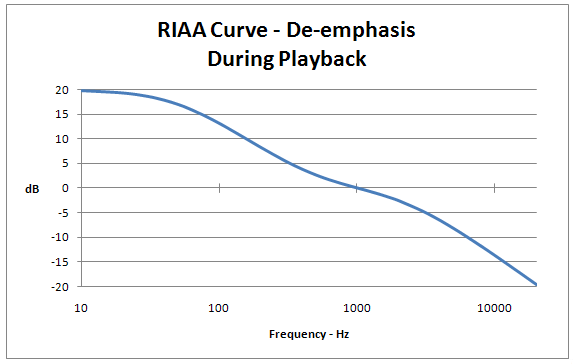
    I think if you look at RIAA Curve de-equalization, it might give clearer picture of vinyl frequency response.


    As you can see high frequecy are attenuated at 6 db/per octave (double frequency), and at 19khz there is 20 dB attenuation which mean any usable bandwidth will be below 19 khz. And if you count wear, dust, dirt, inner groove distortion, misalignment, etc.., your high frequecy response will be much lower than 19khz.

    Quote Originally Posted by Sir TT
    Does it really matter if you cannot hear beyond 12khz? Secondly how many LP have such a wide frequency response...hell I can find one that does, but can I randomly pick an LP and it will have signals above 25khz?
    With RIAA frequecy response being between 20-20kz, wouldn't anything above 20khz contain all noise due to attenuation?

  5. #5
    Forum Regular Woochifer's Avatar
    Join Date
    Dec 2001
    Location
    SF Bay Area
    Posts
    6,883
    Quote Originally Posted by phileserver39
    Hi AR. I have had an idea for a while but have thought that it was too simplistic and must be missing something fundamental in nature. I would appreciate your input...

    The laser is a very precise instrument- it is used to accurately read the 0's and 1's on a compact disc which is spinning at high speed. Analog rules because it there is no need to sample or "dumb down" the signal to 0's and 1's. Why not marry the two technologies?

    After all, the problem with analog lay with the quality of the needle, cartridge, tone arm, platter, etc. Any physical contact between the needle and record, for instance, will ensure that the next time the record is played, it will not sound EXACTLY the same.

    If we could use lasers to read an analog format I think that we could get the best of both worlds. Your thoughts?
    Been there, done that. Early on in the development of the CD format, there were plenty of discussions about whether the CD would be an analog optical format, similar to the Laserdisc format, which already used an analog FM audio carrier.

    As others have mentioned, there are already laser turntables that play LPs.
    Wooch's Home Theater 2.0 (Pics)
    Panasonic VIERA TH-C50FD18 50" 1080p
    Paradigm Reference Studio 40, CC, and 20 v.2
    Adire Audio Rava (EQ: Behringer Feedback Destroyer DSP1124)
    Yamaha RX-A1030
    Dual CS5000 (Ortofon OM30 Super)
    Sony UBP-X800
    Sony Playstation 3 (MediaLink OS X Server)
    Sony ES SCD-C2000ES
    JVC HR-S3912U
    Directv HR44 and WVB
    Logitech Harmony 700
    iPhone 5s/iPad 3
    Linksys WES610


    The Neverending DVD/BD Collection

    Subwoofer Setup and Parametric EQ Results *Dead Link*

  6. #6
    Suspended
    Join Date
    Mar 2002
    Location
    St. Louis, MO, USA
    Posts
    10,176
    I don't know if it is technically "brick wall" filtering but current CDP's absolutely still have filtering. My player is a current model and I actually can choose between two different filter slopes. I really believe this filtering is how manufacturers are able to achieve certain sound characteristics they like for their unit to have.

  7. #7
    Suspended
    Join Date
    Mar 2002
    Location
    St. Louis, MO, USA
    Posts
    10,176
    Smokey, take a look at this, I found it very interesting and supports what i said earlier about not hearing LP's lack of dynamic range compared to CD. I also would like to state I am not a hardliner for either format.
    http://www.audioholics.com/education...-part-4-page-2

    Sir T & Smokey, this clearly shows LP goes beyond 25khz
    http://www.youtube.com/watch?v=4eC6L3_k_48

    As I stated I use both CD and LP, and not hard line on either side but LP as a format isn't as handicap as you want to make it out to be.

  8. #8
    M.P.S.E /AES/SMPTE member Sir Terrence the Terrible's Avatar
    Join Date
    Jul 2002
    Posts
    6,826
    Quote Originally Posted by Mr Peabody
    Smokey, take a look at this, I found it very interesting and supports what i said earlier about not hearing LP's lack of dynamic range compared to CD. I also would like to state I am not a hardliner for either format.
    http://www.audioholics.com/education...-part-4-page-2

    Sir T & Smokey, this clearly shows LP goes beyond 25khz
    http://www.youtube.com/watch?v=4eC6L3_k_48

    As I stated I use both CD and LP, and not hard line on either side but LP as a format isn't as handicap as you want to make it out to be.
    Does it really matter if you cannot hear beyond 12khz? Secondly how many LP have such a wide frequency response...hell I can find one that does, but can I randomly pick an LP and it will have signals above 25khz? That is the question to me..I always knew that LP had a wider frequency response up top, that was never the issue.

    Most of what he picked up on the analyzer wouldn't be audible anyway, as there was not that much output above 25khz. If we could hear that high, the signals would have to be as strong on top as they were near the bottom of the range. It was clearly not that close, and there wasn't THAT much output up there.
    Sir Terrence

    Titan Reference 3D 1080p projector
    200" SI Black Diamond II screen
    Oppo BDP-103D
    Datastat RS20I audio/video processor 12.4 audio setup
    9 Onkyo M-5099 power amp
    9 Onkyo M-510 power amp
    9 Onkyo M-508 power amp
    6 custom CAL amps for subs
    3 custom 3 way horn DSP hybrid monitors
    18 custom 3 way horn DSP hybrid surround/ceiling speakers
    2 custom 15" sealed FFEC servo subs
    4 custom 15" H-PAS FFEC servo subs
    THX Style Baffle wall

  9. #9
    M.P.S.E /AES/SMPTE member Sir Terrence the Terrible's Avatar
    Join Date
    Jul 2002
    Posts
    6,826
    Bob Ludwig, generally considered one of the top LP mastering engineers in the business, has consistently stated over the years that you have to tweak with the LP to get it to sound right. But, he also says that under no circumstances will you ever get an LP playback to sound transparent to original source. Keep in mind that this is someone whose work I have a great deal of respect for, and in many cases, the LPs that he mastered subjectively sound much better than the CDs (for example, the LPs he mastered for Rush). By comparison, he has stated that high res digital (he prefers 192/24 PCM) can sound indistinguishable from the original master.
    Bernie Grundman said exactly the same thing. When I posted that in the analog forum, I was shouted down, and Grundman experience was quite frankly discounted by folks that seemed to know more than he does. Ludwig, Grundman, Ainley, and Elliot Schneiner have all said this, but apparently the armchair listener know more than these guys do.
    Sir Terrence

    Titan Reference 3D 1080p projector
    200" SI Black Diamond II screen
    Oppo BDP-103D
    Datastat RS20I audio/video processor 12.4 audio setup
    9 Onkyo M-5099 power amp
    9 Onkyo M-510 power amp
    9 Onkyo M-508 power amp
    6 custom CAL amps for subs
    3 custom 3 way horn DSP hybrid monitors
    18 custom 3 way horn DSP hybrid surround/ceiling speakers
    2 custom 15" sealed FFEC servo subs
    4 custom 15" H-PAS FFEC servo subs
    THX Style Baffle wall

  10. #10
    Suspended
    Join Date
    Mar 2002
    Location
    St. Louis, MO, USA
    Posts
    10,176
    Quote Originally Posted by Sir Terrence the Terrible
    Bernie Grundman said exactly the same thing. When I posted that in the analog forum, I was shouted down, and Grundman experience was quite frankly discounted by folks that seemed to know more than he does. Ludwig, Grundman, Ainley, and Elliot Schneiner have all said this, but apparently the armchair listener know more than these guys do.
    Some "armchair listeners" may not have more knowledge but they know what they prefer. Knowing a professional prefers digital isn't going to make some one else go digital when they prefer vinyl. Presenting the information is all one can do.
    Last edited by Mr Peabody; 08-28-2010 at 06:13 AM.

  11. #11
    M.P.S.E /AES/SMPTE member Sir Terrence the Terrible's Avatar
    Join Date
    Jul 2002
    Posts
    6,826
    Quote Originally Posted by Mr Peabody
    Some "armchair listeners" may not have more knowledge but they know what they prefer. Knowing a professional prefers digital isn't going to make some one else go digital when they prefer vinyl. Presenting the information is all one can do.
    I didn't make the comment out of a preference frame, I made it out of an accuracy claim. As I have said many a time, some people like their food plain so they can taste the food, and some folks like to doctor the food up.
    Sir Terrence

    Titan Reference 3D 1080p projector
    200" SI Black Diamond II screen
    Oppo BDP-103D
    Datastat RS20I audio/video processor 12.4 audio setup
    9 Onkyo M-5099 power amp
    9 Onkyo M-510 power amp
    9 Onkyo M-508 power amp
    6 custom CAL amps for subs
    3 custom 3 way horn DSP hybrid monitors
    18 custom 3 way horn DSP hybrid surround/ceiling speakers
    2 custom 15" sealed FFEC servo subs
    4 custom 15" H-PAS FFEC servo subs
    THX Style Baffle wall

  12. #12
    Suspended
    Join Date
    Mar 2002
    Location
    St. Louis, MO, USA
    Posts
    10,176
    Quote Originally Posted by Sir Terrence the Terrible
    Does it really matter if you cannot hear beyond 12khz? Secondly how many LP have such a wide frequency response...hell I can find one that does, but can I randomly pick an LP and it will have signals above 25khz? That is the question to me..I always knew that LP had a wider frequency response up top, that was never the issue.

    This is a very dismissive attitude and statement when presented with the facts, much like an "arm chaire listener" might do. Both CD and LP go beyond 12khz thankfully, so one's hearing range is irrelevant.

    What was the issue? I first thought "dynamic range" until you said in reply to, "the brick wall at 20 khz, and 20 hz for example with cd's, while vinyl goes far below 20 hz, and very far above 20khz, without problems

    Sir T, "Vinyl does not go below 20hz, as there is no way a stylus would stay in the groove at that frequency. The CD format does not have brickwall filters at 20hz, it is at 5hz. Vinyl barely goes above 20khz, and probably peaks at somewhere around 25khz, of which the difference between 22.5khz of CD, and 25khz of vinyl represents about a single note on a scale."

    At which point I became curious and found the bit of information I posted. You, are welcome to do with it what you will but you shouldn't be so judgmental of how others take your information without first cleaning off your own stoop.

    For the record Mobile Fidelity's vinyl prssing of 1812 Overture is said to extend from 8hz to 50khz. Probably not typical but I guess the range is there if one wanted to use it. A lot like CD would certainly sound better if it wasn't so compressed and record levels maxed out.

    Most of what he picked up on the analyzer wouldn't be audible anyway, as there was not that much output above 25khz. If we could hear that high, the signals would have to be as strong on top as they were near the bottom of the range. It was clearly not that close, and there wasn't THAT much output up there.
    That's open to interpretation I suppose and it's true our hearing is certainly limited but from what I understand the wide frequency response is necessary for harmonics. I don't know how much value you personally place on harmonics but from a training seminar I attended with JBL/Harmon Kardon they presented a convincing case.

  13. #13
    M.P.S.E /AES/SMPTE member Sir Terrence the Terrible's Avatar
    Join Date
    Jul 2002
    Posts
    6,826
    Quote Originally Posted by Mr Peabody
    That's open to interpretation I suppose and it's true our hearing is certainly limited but from what I understand the wide frequency response is necessary for harmonics. I don't know how much value you personally place on harmonics but from a training seminar I attended with JBL/Harmon Kardon they presented a convincing case.
    No, look at the meter, it is not open to interpretation. Above 20khz, the meter sat at just the point above baseline of the measuring device, which means it would not be heard, it would be masked (precedence effect) by the louder signals below 20khz.

    If you have actually read my post, I value harmonics, timbre and textures in music very highly. But I also know that most folks couldn't hear the harmonics if they tried. From my experience there is a value in keeping unheard ultra sonic signals intact, even if the listener cannot really hear them.
    Sir Terrence

    Titan Reference 3D 1080p projector
    200" SI Black Diamond II screen
    Oppo BDP-103D
    Datastat RS20I audio/video processor 12.4 audio setup
    9 Onkyo M-5099 power amp
    9 Onkyo M-510 power amp
    9 Onkyo M-508 power amp
    6 custom CAL amps for subs
    3 custom 3 way horn DSP hybrid monitors
    18 custom 3 way horn DSP hybrid surround/ceiling speakers
    2 custom 15" sealed FFEC servo subs
    4 custom 15" H-PAS FFEC servo subs
    THX Style Baffle wall

  14. #14
    Suspended
    Join Date
    Mar 2002
    Location
    St. Louis, MO, USA
    Posts
    10,176
    RGA, must you always go to extremes? I have a very competent CDP, my Rega Planar 3 and cartridge is able to hold it's own against it. They sound different but I enjoy listening to both. The point being is you can pick up a P3 and cart for less than $2500.00 and it sounds high end enough to fully demonstrate the strengths of vinyl. Frenchmon recently started running an entry Music Hall and that was enough he could tell the difference from mass market tables like Technics. You make it sound like some one either has to have $2500.00 or greater, or forget vinyl. When Frenchmon heard my rig he could also hear how mine was quieter. So my conclusion would be that turntables are no different than any other component in the way you have different levels with different abilities. So you measure what table you need by what system you have or plan to have. Actually, it was a mere P2 that put my jaw on the floor from the Pioneer rig I previously had. It was a huge improvement.

  15. #15
    Suspended
    Join Date
    Mar 2002
    Location
    St. Louis, MO, USA
    Posts
    10,176
    RGA, you may be meaning to poke a jab at Geoffcin but if any one is paying attention you are off base on the Alpha 9. It sold for $1600.00 to $1700.00 and beat many players costing more than that. It's not mid-fi at all, the 9 would easily give some one a taste of high end digital playback. From what you used in your signature you have never owned a CD playback as good as the Alpha 9.

  16. #16
    RGA
    RGA is offline
    Forum Regular
    Join Date
    Nov 2003
    Posts
    5,539
    Quote Originally Posted by Mr Peabody
    RGA, you may be meaning to poke a jab at Geoffcin but if any one is paying attention you are off base on the Alpha 9. It sold for $1600.00 to $1700.00 and beat many players costing more than that. It's not mid-fi at all, the 9 would easily give some one a taste of high end digital playback. From what you used in your signature you have never owned a CD playback as good as the Alpha 9.
    The fact that something beats something else at a higher price doesn't mean much when the reviewers who say it are being vague. What specifically have they auditioned and what specific model do they claim it beats? Of course the Alpha 9 will sound better than some CD players at more money - big deal - so did the Arcam Delta 290 I owned. The 290 was about half the price of my Pioneer Receiver and the Delta 290 sounded FAR FAR better. So what. The Pioneer was a pile of garbage. Beating a pile of garbage is one thing beating serious audio focussed amps is entirely different. And there were $2k Denon and Sony CD players back then.

    The Arcam Delta 290 that Stereophile reviewed they raved about just like they raved about the alpha cd players - the amp was the only class B amp remotely in that price range back then. The Sugdens (any of them at the time) destroyed the Arcam. Stereophile however would not review any of them because they didn't have enough dealers or they just never heard of them. For YEARS they recommended the Arcam as the best in class. Then John Marks finally reviewed an A21a and they gave it a paragraph blurb and he liked it. Then on a forum he said to me that it was to him the best SS amp in its class on sound. Yes the Sugden needs HE speakers but that's not the issue the issue is pure sound. So you have Stereophile recommending an amp that people might think is best in class and when they finally review the A21a which was selling during the entire Delta 290 production run and they said gee the A21a is actually the better amp. That goes to listening experience and something may be the "best you ever heard" but if you have not heard stuff that is "stiff competition" then it doesn't mean anything.

    It always comes down to experience. When I first began on forums I was a HUGE fan of B&W and Bryston and that's what I was going to buy. And I compared it to lots of other stuff and it always held up quite well - but that's because the lots of other stuff was pretty much exactly the same or similar enough. I think I shifted to Classe and YBA and Sugden and then I shifted partly to Martin Logan (except the mismatch) and to PMC and then Reference 3a. Something is best until something else moves you off the stance and that can only come with experiencial listening.

    The guys who get on my case seem to be the "I've owned my panel for 25 years and I have never heard a better speaker" - to that I say what have you actually heard in the form of boxes. "Nothing - it's a box it can't be good" I swear this was a comment I heard from a guy at Soundhounds. This maggie owner is in a shop selling multi-thousand dollar speakers ANY of which blow his speakers to the weeds and he doesn't even bother to listen- not even for 1 minute because he just "knows" it can't be good.

    No reviewer can hear it all - the fact that a reviewer says - this is better than CD players or amps at double the price that depends on what he heard. And 3 issues later he may hear an amp at half the price that he likes better.

    I reviewed the Grant Fidelity Rita at $4200 at the time which I thought was a very nice sounding amplifier (and it still is) for the money with great build quality. I give it a very nice review. Then GF sends me PM 150 monoblock amps that sell for $1600 (now) which with a decent $1200-$1500 preamp would be easily the way to go(it was with my Rotel).

    So for less money I heard something that is quite a bit better than the Rita. Both of these sound better than amps I have heard at "double the price" too. So what? I would buy a Rita over a $7000.00 McIntosh I heard. And I would buy the PM 150 over the Rita or the McIntosh too(I am being specific). But that doesn't mean that some other amps don't paste the GF and Shengya's either. I would buy the PM 150 and Rotel over more expensive Bryston, Sim Audio, MF, Classe amps as well.

    Regarding CD players:

    What I own and what I have heard are not the same thing. I chose to invest $5,000 into the turntable plus a record cleaning machine. I was reviewing CD players so I felt that before I jump into CD I will simply review a few of them until something comes in that impresses me enough to keep. My dealer has a wide array of turntables and I feel that it is far easier to hear the greater leaps and bounds in vinyl. When you upgrade a $50 cart to a $300 cart you will hear a HUGE difference assuming the table is even remotely competent and a Technics 1200 is that. But if you go from a $600CD player to an $850 CD player that difference is not necessarily even audible and if it is it won't be earth shakingly better. That same $250 yields far more improvement with turntables.

    The Grant Fidelity CD player I reviewed sounds far better than the Alpha 9 and the build quality isn't even comparable - the Alpha 9 is a toy. Sure both are better than the CD 6. But so what? I can still recognize which sounds better whether I own the player or not. I keep it because it is interesting to have a reference of what was considered "entrey level high end" in the mid/late 90s to hear how much better new players truly are. The GF is a tube cd player and the one I am reviewing now is a tube cd player. Both of them easily outperform the likes of the CD 6 and any of the Arcams. The GF's are worth the money for the transports alone. i give that praise to it not because I own it because I don't. It just is that well built. I wish the Audio Note gear was that well built - it isn't up to that level either.

    And if the Shengya CD player is as good as the the PM 150 then the Arcam will be relegated to laughing stock status. The PM 150 embarasses th elikes of the Delta 290. And I would not be surprised if it did the same thing to their digital. $750 http://grantfidelity.com/site/Sheng_ya_CD-17
    Last edited by RGA; 08-29-2010 at 01:43 PM.

  17. #17
    Suspended
    Join Date
    Mar 2002
    Location
    St. Louis, MO, USA
    Posts
    10,176
    I'd like to know which Bryston amps got bad reviews. Stereophile liked the big monoblocks.

  18. #18
    RGA
    RGA is offline
    Forum Regular
    Join Date
    Nov 2003
    Posts
    5,539
    Quote Originally Posted by Mr Peabody
    I'd like to know which Bryston amps got bad reviews. Stereophile liked the big monoblocks.
    Fremer's review of the 7B SST2 in Stereophile
    UHF's review of the 3B or 4B but I believe it was the 3B
    Hi-Fi Choice review of the 100 integrated.


    This is what Fremer had to say

    Against the Parasound Halo JC 1s
    The Parasounds couldn't have sounded more different. Their bass was deeper, tighter, and better controlled, yet not overdamped, so that textures were fully resolved, and rhythm'n'pacing were far more nimble. Image specificity was greater, and dimensionality was more fully expressed. Transients were faster and more effervescent while being free of artificial etch. Reverb was expressed as genuine depth where appropriate, dropping way down in level into the noise floor before dissipating. Images leapt from the speakers and floated more freely in a huge three-dimensional space—but most noticeable, and almost immediately, was the delicacy, resolution, and coherence of the reverb's decay.

    Neither pair of Brystons matched the Parasounds' low-level resolution and microdynamic delicacy. With the much nimbler, more holographic-sounding Parasounds there was more musical information to consider and more musical pleasure to be had. Detractors might say the Halos' top end was brash, but I counter that that was the fault of the recordings, not the amps, which had a sweet top end despite all their resolution and transparency.

    Conclusion
    If I owned a pair of Bryston 7B SST2s, I'd make sure to find out whether they contained the old or new transformers. The improvement produced by the new transformers was significant.

    Nonetheless, even the improved version, while sounding pleasant enough—and particularly rich in the midrange—couldn't get my Wilson Audio MAXX 3 speakers to live up to their sonic potential, despite having enough power to do so. It's not a matter of cost—the similarly priced Parasounds did so with ease.

    But while the better of the two pairs of Bryston monoblocks always sounded pleasant, they rarely sounded exciting. The original pair elicited this conclusion: "I listened happily to the pair of them for a month, concentrating on the many things they did well. But their presentation was sort of like tofu: nourishing, but in need of spicing up to be truly tasty. Replacing the darTZeel NHB-18NS preamplifier with Musical Fidelity's all-tube Primo added needed texture and dimensionality. The Audio Valve Sunilda phono preamp added interest. Changes of cable produced useful results. But overall, the Brystons' presentation lacked the microdynamics I was used to from the Musical Fidelity Titan."

    While the second pair of 7B SST2s was clearly an improvement over the first, that conclusion stands. In my experience, it is hard to beat a lot of good, clean power, and the Bryston 7B SST2 offers that, plus ultra-low distortion, in a superbly built, reliable package at a very reasonable price. But before buying a pair, listen to the competition.
    http://www.stereophile.com/solidpowe...er/index4.html

    Here is the problem - microdynamics and it has always been a problem for me with every system I have tried Bryston in. I have to crank it up to make certain cues out. Where they and many other SS amps fall down is on transients and decays. SS does a fine job of getting the initial sound but not the edges of notes and so I hear an up front crisp clear strike and it sounds hacked off. It simply doesn't have the resolution with simple instruments (one vocal one guitar) and I use that kind of music before I bother with full scale orchestra. Yes separation is all fine and good and re-creating high volume level orchestra is all fine and nice but if you can't simply get the timbre and tone, transietn attack and decay of one guy playing one guitar then nothing else it brings to the table can be worthwhile because it certainly isn't getting that right with 20 instruments - it's just spacing it all out. With 20 instruments though it's far harder to hear the attack and decay of each instrument because there are so many playing all at the same time so the weakness goes unnoticed. But since most music is not played at 120db and has 110 piece orchestras - most music is of the small scale single voice with a backing band of 4 to 5 instruments it is here that most systems fall down. A small tube system will get the instruments and vocals better but may have trouble with the spatial cues at higher levels and jumble them up in the center more. But that compromise IMO is easily the better one because if the violin and cello sound "real" whether they are well spaced is less important since we were not at the event or the recording studio and the spatial cues are not a known entity. The sound of a violin or a piano however is. Microdynamics are critical (all dynamics are critical) and it's what few systems do well.

    I'm not saying put all your stock into Fremer but his comments are not dissimilar to the others over the years from UHF or Hi-Fi Choice or what I and numerous other forum posters hear. Having said all that I would still consider them for my home theater set-up down the line. Why? Because they sound a lot like most SS amps of this stripe and they have a great warranty and support. For music replay not my cup of tea but for home theater where cues are less experientially known and big slam bang effects it is impressive. Also safe to buy used because you can flip them easily.

  19. #19
    It's just a hobby
    Join Date
    Oct 2004
    Location
    London, UK
    Posts
    808

    A testament to the unreliability of purely subjective reviews

    Quote Originally Posted by RGA
    This is what Fremer had to say

    But while the better of the two pairs of Bryston monoblocks always sounded pleasant, they rarely sounded exciting. The original pair elicited this conclusion: "I listened happily to the pair of them for a month, concentrating on the many things they did well. But their presentation was sort of like tofu: nourishing, but in need of spicing up to be truly tasty. Replacing the darTZeel NHB-18NS preamplifier with Musical Fidelity's all-tube Primo added needed texture and dimensionality. The Audio Valve Sunilda phono preamp added interest. Changes of cable produced useful results. But overall, the Brystons' presentation lacked the microdynamics I was used to from the Musical Fidelity Titan."

    While the second pair of 7B SST2s was clearly an improvement over the first, that conclusion stands. In my experience, it is hard to beat a lot of good, clean power, and the Bryston 7B SST2 offers that, plus ultra-low distortion, in a superbly built, reliable package at a very reasonable price. But before buying a pair, listen to the competition.
    http://www.stereophile.com/solidpowe...er/index4.html

    I'm not saying put all your stock into Fremer but his comments are not dissimilar to the others over the years from UHF or Hi-Fi Choice or what I and numerous other forum posters hear. Having said all that I would still consider them for my home theater set-up down the line..
    A counterpoint to Micheal Fremer review by Larry Greenfield

    The 28B-SST's reproduction of HUGE dynamic contrasts in synthesizer recordings was accompanied by an ability to reveal emotionally evocative musical details ... Come to think of it, the 28B-SST is just the right amplifier to capture the raw power, passion, sonorities, and subtle inner details of Golijov's Azul, should a recording of the work ever be released. I can't wait.
    Larry Greenfield felt the 28B-SST did not lack microdynamics, who to believe, Micheal Fremer (7B-SST) or Larry Greenfield(28B-SST)?
    It's a listening test, you do not need to see it to listen to it!

  20. #20
    RGA
    RGA is offline
    Forum Regular
    Join Date
    Nov 2003
    Posts
    5,539
    Quote Originally Posted by theaudiohobby
    Larry Greenfield felt the 28B-SST did not lack microdynamics, who to believe, Micheal Fremer (7B-SST) or Larry Greenfield(28B-SST)?
    Yes I suppose it would be a good idea to listen to them and make the call.

  21. #21
    Silence of the spam Site Moderator Geoffcin's Avatar
    Join Date
    May 2003
    Location
    NY
    Posts
    3,326

    I really like Mikey.

    The business would not be the same without him. He certainly has opinions on gear, but most of them I don't agree with. I remember he famously threw a tantrum because JA wasn't going to give a very expensive tube ($250k!) amp a class "A" rating after JA had found that it missed all of it's stated measuments by a LARGE margin, had a huge amount of distortion at anything more than just a few watts, and had an output impedence so high that it would swing the speakers +/- 10dB! Mikey just LOVED it though!! Sure, he's into excitment. Amps that are dead flat with no ringing or overshoot and with enough damping to control his puppies leave him feeling flat. Doesn't surprise me in the slightest.
    Audio;
    Ming Da MC34-AB 75wpc
    PS Audio Classic 250. 500wpc into 4 ohms.
    PS Audio 4.5 preamp,
    Marantz 6170 TT Shure M97e cart.
    Arcam Alpha 9 CD.- 24 bit dCS Ring DAC.
    Magnepan 3.6r speakers Oak/black,

  22. #22
    RGA
    RGA is offline
    Forum Regular
    Join Date
    Nov 2003
    Posts
    5,539
    Strictly speaking I don't agree with Fremer or UHF or Hi-fi Choice all the time either (rarely in most cases). Fremer is a big power SS fanboy however so coming from a SS guy criticism means more perhaps than if I or tube supporters critique the stuff. The manufacturer generally gets a choice of who does the review so ....

  23. #23
    Silence of the spam Site Moderator Geoffcin's Avatar
    Join Date
    May 2003
    Location
    NY
    Posts
    3,326
    Quote Originally Posted by RGA
    Strictly speaking I don't agree with Fremer or UHF or Hi-fi Choice all the time either (rarely in most cases). Fremer is a big power SS fanboy however so coming from a SS guy criticism means more perhaps than if I or tube supporters critique the stuff. The manufacturer generally gets a choice of who does the review so ....
    Mikey is one of the best reviewers in the business. It's always a pleasure to read what he writes, even if I don't agree with all of it. He's also an analog-is-always-best guy too. The guy lives for vinyl! That's OK with me too.

    Here's the review of the monster Wavac I alluded to earlier;

    http://stereophile.com/tubepoweramps...ac/index5.html

    I'm giving Mikey a pass on this one. I think big ticket items can put stars in peoples eyes. And even if they don't live up to the hype it's hard to escape the feeling of using something that only a few will ever have a chance to.
    Audio;
    Ming Da MC34-AB 75wpc
    PS Audio Classic 250. 500wpc into 4 ohms.
    PS Audio 4.5 preamp,
    Marantz 6170 TT Shure M97e cart.
    Arcam Alpha 9 CD.- 24 bit dCS Ring DAC.
    Magnepan 3.6r speakers Oak/black,

  24. #24
    It's just a hobby
    Join Date
    Oct 2004
    Location
    London, UK
    Posts
    808
    Quote Originally Posted by RGA
    Strictly speaking I don't agree with Fremer or UHF or Hi-fi Choice all the time either (rarely in most cases). Fremer is a big power SS fanboy however so coming from a SS guy criticism means more perhaps than if I or tube supporters critique the stuff. The manufacturer generally gets a choice of who does the review so ....
    Errr....in Stereophile's case, that's not correct.
    It's a listening test, you do not need to see it to listen to it!

  25. #25
    RGA
    RGA is offline
    Forum Regular
    Join Date
    Nov 2003
    Posts
    5,539
    Quote Originally Posted by theaudiohobby
    Errr....in Stereophile's case, that's not correct.
    Well let's just say that if the manufacturer doesn't like who is reviewing the product they don't have to have the product shipped. This is also why you see certain reviewers at magazines including Stereophile review a lot of the same products as ones they already own or have reviewed in the past. The Stereophile reviewer who owns Paradigm gets paradigm, the one who likes SETs or panels gets SETs or panels. Whatever their claims it is fairly obvious who is getting what kind of gear. But it may be just coincidence.

Page 2 of 4 FirstFirst 1 2 3 4 LastLast

Thread Information

Users Browsing this Thread

There are currently 1 users browsing this thread. (0 members and 1 guests)

Posting Permissions

  • You may not post new threads
  • You may not post replies
  • You may not post attachments
  • You may not edit your posts
  •