Quote Originally Posted by nightflier
I would say that a non-matching center would be better than none at all. I would suspect that not having a center would spread out the sound too much away from the center stage, where most of the attention should be. It would also no longer be true multi-channel (quadrophonic?).

That said, I do think that Feanor would get much better results with matching speakers.
With multichannel music, generally the center speaker is not as important as it is with home theater sources because most recording engineers have decided to use the center channel on a minimal basis when doing 5.1 music. I do agree though that if you can find a sufficiently matching center speaker, then you should go with it simply because the center channel is discrete. The center channel mixdown process that the processor engages in when the center channel is inactive, is done to predefined proportions and does not always result in a stable phantom center image. With a discrete center channel in place, the mixing engineer is not purposely EQing and otherwise processing the signal the same way that they would when mixing for a phantom center with two-channel and 4.1 mixes.

Quote Originally Posted by nightflier
Also, I am very curious about how a lower-end surround music setup differs from a higher end one. This is of interest to me because I find myself a bit underwhelmed with what I've put together, and I think I may not be the only one who feels that way. SACD & DVD-A are a significant improvement over RBCD, but I still have this nagging feeling that I'm not getting everything out of my setup.
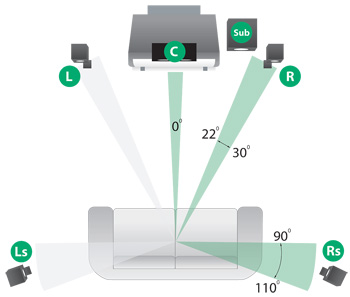
I think you might want to experiment more with the speaker placement, the delay timing, and level adjustments. The diagram below shows the ITU reference alignment. This is how studios typically arrange their monitoring setups for multichannel music mixing. This will optimize the surround imaging with multichannel music, but might compromise the surround effect for a lot of 5.1 movie soundtracks, particularly those that primarily use the surrounds for ambient cues and don't use a lot of directional effects. Dolby recommends that if your system is used for both movies and multichannel music, you should elevate the surround speakers above ear level and point them directly at one another. That diffuses the sound enough so that the surrounds don't sound like point sources with ambient sounds, while preserving just enough of the directionality to hear the surround imaging with more directional sources.


Quote Originally Posted by nightflier
If I remember right, SACD requires five identical speakers and they need to be positioned differently than a typical HT setup. If so, SACD really won't sound as the original mixing engineers intended through a HT setup, which typically has a wide-dispersion center channel and more diminutive rear channels. Of course, some engineers may actually compensate for this because they realize most people don't have a dedicated SACD setup. [Come to think of it, this may be another reason why Sony was lukewarm about pushing SACD and decided to push for the DTS standard instead. I wonder...]
The diagram that comes with SACDs is actually the ITU reference alignment -- it's not format specific since DD, DTS, DVD-A, and SACD mixes have all used that alignment in studio mixing setups. Ideally you would go with five identical speakers all the way around, but in no way is that a requirement. You would definitely optimize your multichannel music playback by going with identical speakers, but most setups have to perform double duty and if you have a TV, it usually sits exactly where the center speaker would ideally go. That's why Dolby has its recommendation of elevating the surround speakers high and pointing them at one another -- it simply represents the best compromise for systems that are asked to do both. Your question is not a format specific issue because even a music DVD with a DD soundtrack will be affected by how you place the speakers and how well they timbre match.