Quote Originally Posted by theaudiohobby
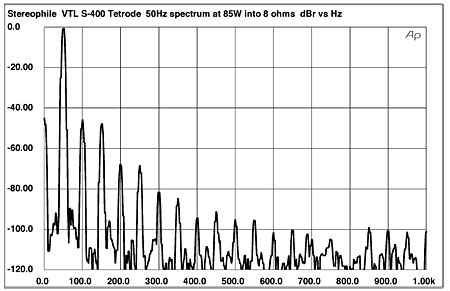
Well, here is a VTL reference tetrode amplfier


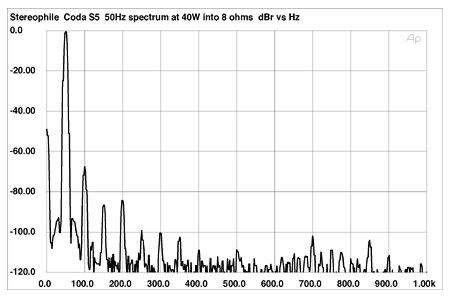
Now here is an SS


I hope you catch the significance of that graph, it clearly shows (even more clearly than the previous example) that the VTL has higher distortion across the whole spectrum.

What is your definition of more linear? it seems that you overlooked the scaling in the graph, The final distortion harmonics shown for the SET are considerably larger and it also has a higher noisefloor. as stated previously it has higher distortion across the whole spectrum.
I have done very little listening to tube equipment, unfortunately -- except for my Behringer T1951 "tube" equalizer. So I don't presume to have an opinion as to whether tubes or SS sounds better.

Nevertheless the graphs presented by both E-Stat and theaudiohobby do not present a convincing evidence of the usual argument in favor tubes. I have often heard that tubes produce mainly 2nd order harmonics and generally less odd-order harmonics than SS.

But it is clear from both sets of graphs that the tubes are producing far more distortion overall, including 3rd and higher odd-order harmonics. In the E-Stat's graph, it isn't until you get 7th order harmonics that the SS distortion becomes higher than the tube's. At point the distortion is very low in total, although I suppose you could say it's significant. Is there any objective evidence that it is significant?

By the way, by Behringer does soften the sound, depending on the tunable "warmth" setting. Behringer is up-front about the fact that it does this by introducing distortion. The unit also sligtly reduces micro dynamics. As far as I'm concerned the tube effect in this case is useless and I only continue to use the EQ for the equalization which is certainly worthwile.