I agree with you on this. Years ago when I got a 12 band equalizer I used an LP with test tones and a Radio Shack SPL meter to equalize my system flat(er). It was intolerably bright and harsh. After doing some research (not easy in the days before the internet) I found that a 6dB per octave roll off centered on 16KHz made the sound subjectively much better. I set the 16KHz slider at -6dB. Because of the way the controls on an octave equalizer work this gave me roll off starting at ~8KHz. I continued to use the settings my measurements suggested for the lower frequencies.Quote:
Originally Posted by Feanor
When I visit someone with an equalizer with a smiley face I'm reluctant to ask for a listen. If that smiley face is coupled with some JBL's or Klipsch speakers I go out of my way to not listen.
The overly accentuated top end of many modern speakers coupled with my sensitivity to a harsh treble makes many newer speakers unlistenable to me. What I call the "hyper-fi" sound just doesn't work for me.
New set-up does not sound the way it should.
Printable View
-
02-23-2013, 03:40 PMJoeE SP9
-
02-23-2013, 06:50 PMStevenSurprenant
Do you think this brightness is just the nature of speakers or that recordings are made too bright?
I ask this because some records sound just right at flat settings. Actually the very best recordings I have sound very good at flat, the rest, not so much.
It just seems to me that if care is taken setting levels during recordings that we should get (as much as possible) a faithful reproduction of the actual event. Yet, a number of you have reported a bright sound when your speakers are set flat. That should not be so. If the monitors used during recordings are set flat, you should hear the same thing at home.
Can anyone explain this?
In a nutshell... (thinking to myself)
I should EQ my system flat so it sounds like it did in the studio, but if I do, it will sound bright and harsh, so then I need to EQ it so it doesn't sound like it was recorded.
I just don't get it -
02-24-2013, 05:05 AMFeanor
I don't get either. But in fact, (at least for classical music), measured flat is too bright for almost all recordings.
I wonder if engineers are assuming that in the typical home listening space high frequencies will be absorbed so records will sound dull?? And/or that typical consumer speakers roll off the highs?? If they think this, they are apparently wrong at least for many audiophiles.
I guess also that engineers listen in what is called "near field", i.e. the situation where most of the sound comes directly from the speakers rather than the typical home situation where much sound is reflected from room boundaries. This would relate to their possible assumption that they need more HF to compensate for room absorption. Anyway, they'd be wrong in case of a lot of us. -
02-24-2013, 05:53 AMStevenSurprenant
We do know that engineers play with the sound for different reasons, like compression to make it sound louder, so it's possible that they do other things too. Back in the early years of stereo they used to have one singer coming from one speaker and another from the other speaker. That worked well for console stereos since the speakers were close to each other, but rather distracting in a normal set up today.
Off subject... A rather interesting thing about hard right/left is that with large diaphragm speakers, such as electrostatic speakers, the voices are large and with small bookshelf speakers, the voices can be rather small, but in both cases the voices are only as large as the box or diaphragm. To me, the larger diaphragm sounds better. If the voices contain some ambiance or reverb/echo, then the voices begin to separate from the boxes and appear to be coming from behind the speaker.
You might have something with your comment about near field listening. It might be too that a properly acoustically treated room (like a studio) requires more high frequency energy so they apply it during the recording, but you already said that. If this is the case, then they need to rethink this.
Many years ago I was in a friends Van which had carpeting everywhere and the stereo sounded dead. I could see how boosting the treble could help in this environment.
The mystery continues... -
02-25-2013, 01:13 PMSir Terrence the TerribleOne has to take in consideration that there is more absorption and diffusion in a recording studio than there is in our homes. Most electronic EQ is done below 200hz, and I have never heard of a studio tech doing EEQ above that. And here is a reality, most peoples system are not flat PERIOD! Most people throw up a 1" panel on the walls, and think they have accomplished something. A 1" panel will do you good above 1K, so now the spectral balance of the room has some highs sucked up, but nothing else is controlled. If you are going to take energy out of the room, it must be done in a broad band way, not at extreme's.Quote:
Originally Posted by Feanor
Another thing to consider is the studio monitors versus your own personal choice of speaker. I use either my Dunlavy SC-V's, or my ATC's for mastering my church's stuff.
That same recording is going to sound totally different being reproduced in a highly reflective room, with a ribbon or panel.
How many audiophiles use a RTA to analyze their room/speaker interaction, or a automatic room correction processing in their system? Not many, but my studio systems are calibrated before before each session(whether the need to be, or not), something that never happens at home.
These days most recording studios use subwoofers to augement the main system, or use full or extended range speakers. While the main system(or frequencies above 40hz) is flat overall, and house curve applied to the bottom end of the subwoofer or main monitors(not the console positioned ones) to maintain an overall spectral balance. The house curve compensates for our loss of hearing insensitivity at low frequencies. Without that house curve, a flat speaker will sound overly bright.
How many audiophiles apply a house curve to their system to maintain octave to octave balance in their system? None I would imagine. -
02-25-2013, 01:16 PMSir Terrence the TerribleCompression does not make anything louder, it gently rounds off the peaks of the signal. Aside from turning up a fader, the only thing that can make a signal louder is a expander.Quote:
like compression to make it sound louder
So you understand. It was not compression that started the loudness war, it was severe limiting. -
02-25-2013, 01:24 PMSir Terrence the TerribleOne of the things that always troubles me(and I took a poster on this thread to task for this) is that the end user always assumes it is what we do in the studio that causes all of the problem. You can only make this assumption if your system is perfect in every way, because let's face it, what we hear in the studio is the reference. What happens in the home is the crap shot.Quote:
Originally Posted by Feanor
The best studios I have been in(and mine as well) have been designed, setup, and calibrated so the speaker/room interaction is pretty darn close to neutral. How many people can say this about there own system? Not many, as it is hugely expensive to do this, and it start at the construction of the room.
How many folks pay attention to the NC levels in their room? I have not heard many audiophiles mention this at all.
How many audiophiles pay attention to the RT time in their rooms? Not many based on the forums I visit.
So it the brightness really in the recording, or the way your OWN system is presenting it? I would go for the latter with a caveat - not all recordings are perfect. -
02-25-2013, 01:30 PMSir Terrence the TerriblePerhaps you need to rethink your statement. Studios don't throw up treatments before they place the speakers. The speakers are modeled in the room, placed, tested, and then room treatment is added to make the room sonically neutral. IF they did it in the way you mention here, they would be blowing tweeters left and right trying to compensate for a overly damped room. The object is not to suck all of the highs up, but to neutralize the room sonic signature.Quote:
You might have something with your comment about near field listening. It might be too that a properly acoustically treated room (like a studio) requires more high frequency energy so they apply it during the recording, but you already said that. If this is the case, then they need to rethink this.
What is more likely is there is not enough absorption and diffusion IN YOUR ROOM, and that is why recordings sound so bright.
Why is that nobody wants to take a critical look at their own room and system? Is it because they don't want to admit that it is fundamentally flawed?
This is a prime case of deflection. Blame the engineer, his speakers, and his room for why recordings sound so bright. Ignore the fact that the problem is likely your room, and your speakers and their interaction with each other. -
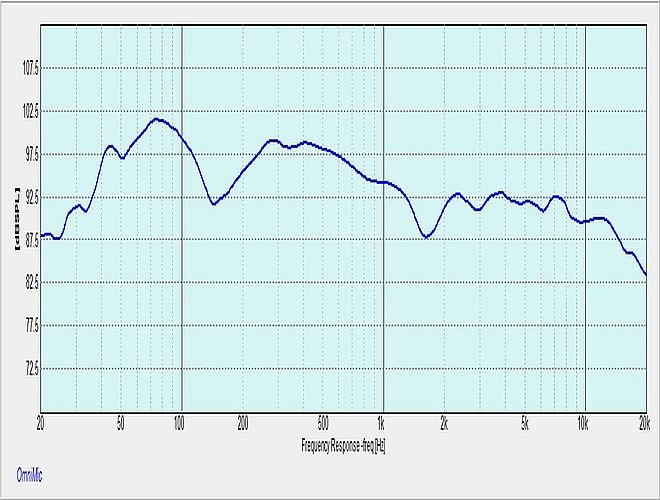
02-25-2013, 01:55 PMFeanorI use OmniMic (from Parts Express) to measure my stereo system. I measure each speaker at three feet. The measurement (with 1/6 octave averaging) looks like this for the right speaker, (it's very similar for the left) ...Quote:
Originally Posted by Sir Terrence the Terrible
Attachment 9206
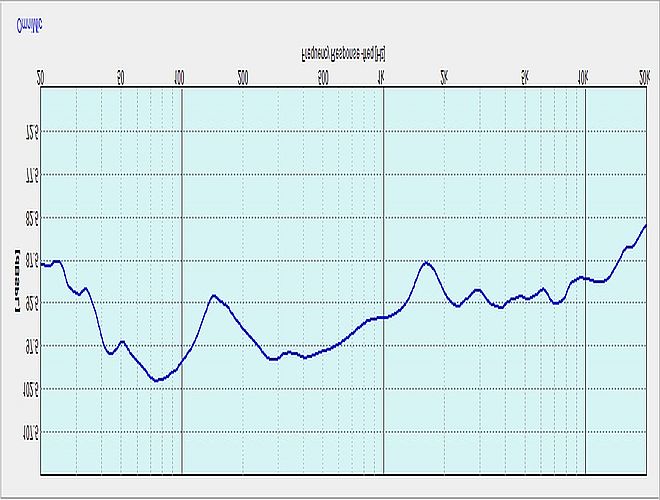
It seem to me for flat response I would need to set the inverse of the above to get flat response. The inverse looks like this ...
Attachment 9207
Getting as close to this as I can I do get quite flat response -- however it sounds far too bright with almost all recordings.
So instead I set up my equalizer, (Electri-Q plugin for Foobar2000), for this effect ...
Attachment 9208
The result is far more natural. My roll-off starts very gradually at about 2kHz but I'm down about 6dB at 10kHz and even more higher up. -
02-25-2013, 02:25 PMSir Terrence the TerribleThe problem with this measurement is that you have a HUGE peak that gradually rises from 500hz to 2khz. 2khz sits right in the middle of where our hearing is most sensitive, and even if you roll of frequencies above that, you are going to still hear brightness.Quote:
Originally Posted by Feanor
IMO Bill, you probably would do better by using room treatments to handle the dips and peaks above 200hz instead of EEQ. I personally would never use EQ above 200hz. It puts you at the mercy of the quality of the EQ algorithms(which could be excellent or very poor). I personally would like to see the non-averaged measurement. Smoothing hides detail.
This measurement(and no offense) is not very flat even after EQ. If you look at the before measurement, and the after Audyssey measurement, you get a ruler flat response(in music mode) from 20hz to 20khz. Most well designed studios(pre house curve) are also extremely flat from 20-20khz. Can you see why you would get a different reproduction result from the difference between a great studio tuning, and what you get on your system? -
02-25-2013, 06:42 PMFeanorThe huge peak you refer to is certainly a problem and is almost caused by room effects. Unfortunately my scope for installing room treatments is small for various reasons.Quote:
Originally Posted by Sir Terrence the Terrible
No offence for sure. I definitely get a much flatter response using the Electri-Q equalizer, i.e. I can get rid of the larger peaks at least -- BTW, I have NOT shown the final measured response 'cause I can find the read-out: I'll need to take it again. But one thing is for sure: when I measured a flat response the sound is far too bright. With the smoothly rolled off response the sound is a lot more natural.
I wouldn't hammer the subject except that my experience is a common one, maybe even a typical one. From what you say the "house curve" is the recording engineers' effort to accommodate a real world listening experience. On the other hand the too-bright results many of us get with measured flat response is apparently being ignored. -
02-26-2013, 10:21 AMSir Terrence the TerribleSo can you see how what we hear in the studio which is uber calibrated, equalized for flat response( no more than 1-2db deviation) over an extremely wide frequency range, and room treated for sonic neutrality?Quote:
Originally Posted by Feanor
I don't think the roll off is the crust of our discussion. Via Auddyssey, I can choose 5 roll off curves, or a uber flat response well beyond 20khz. The problem I see with most people who do the roll off is there is no complementary house curve provided for the bottom end. The house curve, plus the roll off creates the most natural presentation without all of the high frequency energy. A system that does the roll off without the house curve will still sound too bright because you have to compensate for the lack of our ears sensitivity at low frequencies. This is where a big speaker will have a solid advantage over a bookshelf speaker without a subwoofer.Quote:
No offence for sure. I definitely get a much flatter response using the Electri-Q equalizer, i.e. I can get rid of the larger peaks at least -- BTW, I have NOT shown the final measured response 'cause I can find the read-out: I'll need to take it again. But one thing is for sure: when I measured a flat response the sound is far too bright. With the smoothly rolled off response the sound is a lot more natural.
But you don't have a flat response. A flat response has very little deviation from the mean curve. I would say no more than1-2db from 40hz to 12khz. When you can get that kind of frequency response, then one can complain about brightness. When one fully examines their own system and room, then you can complain. But when you are in a untreated room with high frequency energy bouncing all over the place(dispersion not very well controlled), you cannot complain about brightness in the source - especially if we did not hear that effect in the studio when mixing or mastering. As I have said before, the studio is the reference. Everything else is a crap shot.Quote:
I wouldn't hammer the subject except that my experience is a common one, maybe even a typical one. From what you say the "house curve" is the recording engineers' effort to accommodate a real world listening experience. On the other hand the too-bright results many of us get with measured flat response is apparently being ignored.
Quote:
I measure each speaker at three feet
Bill, you are not measuring the speaker/room interaction from this distance - you are measure the speaker. When you want to get a good picture about how your room and speaker are interacting, you have to measure from the listening seat. That measurement from 3ft will be completely different from a measurement taken 6ft away.
Here is something to mull over. Too much high frequency energy can also be a lack of bass. The lack of one thing can perceptively effect another. -
02-26-2013, 02:13 PMFeanorI think I need to repeat that I corrected my unEQ'd response to flat, (OK, almost so: +/-2dB up to 15kHz). Flat is what sounded too bright. EQ'ing for smooth (as opposed to lumpy) roll-off fixed the problem.Quote:
Originally Posted by Sir Terrence the Terrible
Yes, true, the measurements are different. But correcting either near-speaker or listening position to flat produced a too-bright result.Quote:
Originally Posted by Sir Terrence the Terrible
A pundit at AA, (Morricab), explained that the listening position response is a "power response", i.e. measures a total response which is direct+reflected sound. He argued (1) that the D+R response was rolled off in the HF in typical listening rooms, consequently (2) correcting D+R to flat will sound too bright because the ear subliminally distinguishes between to two and favors the direct.
I will likely experiment with this. My question is, which range frequencies ought to be boosted to compensate for the ear's relative insensitivity?Quote:
Originally Posted by Sir Terrence the Terrible
-
02-26-2013, 03:27 PMSir Terrence the TerribleIt sounded to bright because you did nothing to address the bottom end as well. It takes both a roll off, and a house curve to achieve a natural wide band frequency response. In my signature system, I could go flat, or have five roll off curve. Because I deploy a house curve, even if I use the music mode(flat) I still don't experience this brightness you speak about from my sources.Quote:
Originally Posted by Feanor
Disagree here, A flat response near speaker, is a slightly rolled off response at the listening position - that is unless your room is VERY small. Room reflections wiill combine with the direct output of the speaker which will result in a slight roll off of the highs.Quote:
Yes, true, the measurements are different. But correcting either near-speaker or listening position to flat produced a too-bright result.
The problem with this is it does not address the arrival time of the reflections, or how loud they are. Secondly if there is not a sufficient window for the direct arrival, there is no way the ear will be able to distinguish the direct sound from the reflective sound. His comment is very simplified.Quote:
A pundit at AA, (Morricab), explained that the listening position response is a "power response", i.e. measures a total response which is direct+reflected sound. He argued (1) that the D+R response was rolled off in the HF in typical listening rooms, consequently (2) correcting D+R to flat will sound too bright because the ear subliminally distinguishes between to two and favors the direct.
I personally start at 40hz, and work my way down. At 20hz in my system, the response is +6 at 20hz. This takes a very powerful subwoofer with a pretty big excursion capabilities.Quote:
I will likely experiment with this. My question is, which range frequencies ought to be boosted to compensate for the ear's relative insensitivity?
-
02-27-2013, 09:30 AMStevenSurprenantI never said that.Quote:
Originally Posted by Sir Terrence the Terrible
As I mentioned previously, I have many recordings that sound very good without any brightness. I have many more that are very harsh, or bright, or muddy sounding. Some have soundstages that are extremely clear and defined, while some are wallpaper. On others, the singer is front with the background far behind and then there are the ones where the singer is buried with the background.Quote:
This is a prime case of deflection. Blame the engineer, his speakers, and his room for why recordings sound so bright. Ignore the fact that the problem is likely your room, and your speakers and their interaction with each other.
The recordings that I have run the entire gamut of what's good and what it not. There doesn't seem to be a problem with my speakers sounding just the same with all recordings. If you're thinking that I think my speakers are perfect, then you would be wrong. I've never heard a speaker that didn't have it's faults.
It seems to me that since recordings quality vary so much, the prime suspect would be the recordings.
It also occurs to me that if this problem of brightness is fairly standard than it makes no sense to keep doing what you're doing. What you hear in your studio doesn't matter (even though it might be technically correct), it's what we hear at home that we consider the results of your effort . So you can continue to produce what you call technically correct, but if the masses have to keep adjusting their treble down or to dress our homes to look like recording studios, then you have failed in your job. This applies to all recording studios.
One more thing...
Back in my early days I tried using EQ's to adjust the sound, but since there was so much variations in recordings, what made one song sound better made another one sound worse. I gave up and sold the unit. I've tried many times since, with the same results. In the event that sound quality becomes standardized, I will revisit this. However, I just don't think I will live long enough for that. -
02-27-2013, 09:50 AMFeanorI'll try some bass boost, but (1) 20-40 Hz is very far below where I'm presently starting my roll-off, and (2) I doubt that my modest subwoofer will handle much boost in this region; it's vented box wih -3dB at about 30 Hz.Quote:
Originally Posted by Sir Terrence the Terrible
Consistent with your point, my near speaker non-EQ'd measurement shows less roll-off, but correcting even that to flat is still too bright.Quote:
Originally Posted by Sir Terrence the Terrible
Maybe simplification is my recounting rather than Morricab's actual words. Anyway, his basic point is that, in general, direct is sufficiently distinguished from reflected that it's preferable to EQ base on the near-speaker rather than listening position measurement.Quote:
Originally Posted by Sir Terrence the Terrible
I' curious if it's fair to say mastering studio listening positions are typically more like near-field than the typical home room, that is, based no just on actual distance but also the heavily absorbent environment? -
02-27-2013, 11:25 AMSir Terrence the TerribleYou don't have to say it, but the implication in your statement if fairly obvious.Quote:
Originally Posted by StevenSurprenant
Wow, a basic generic comment, how profound. Any one can make this statement, it defines nothing.Quote:
As I mentioned previously, I have many recordings that sound very good without any brightness. I have many more that are very harsh, or bright, or muddy sounding. Some have soundstages that are extremely clear and defined, while some are wallpaper. On others, the singer is front with the background far behind and then there are the ones where the singer is buried with the background.
If you have speakers that sound the same with every recording, you speakers are not very good, or your rooms acoustics are dominating what you hear. Your first statement is subjective at best. Your last statement is meant to bring your system(loaded with compromises) to the same level as a high end system with little or no compromises. I am not impressed with this level of bridging. You actually demean and demote a system with far more capabilities than yours. Do you really think your stereo system is the equal to Ralph's on this board? I don't think so based on what you have described.Quote:
The recordings that I have run the entire gamut of what's good and what it not. There doesn't seem to be a problem with my speakers sounding just the same with all recordings. If you're thinking that I think my speakers are perfect, then you would be wrong. I've never heard a speaker that didn't have it's faults.
It seems to me that since the end user systems also varies so much, then it could be their system as well. You have a penchant for deflection, and Stevie Wonder can see this.Quote:
It seems to me that since recordings quality vary so much, the prime suspect would be the recordings.
It seems to me you would have to do a substantial research project to verify this statement. Since you have not, then it is BS and deflection. If you are listening to what folks are saying around here, your sampling is way too small to come to the conclusion there is a standard. BS somebody else, I am not buying, you are over selling your point as usual.Quote:
It also occurs to me that if this problem of brightness is fairly standard than it makes no sense to keep doing what you're doing.
This is quite frankly one of the most stupid statements I have ever heard on this issue. The studio is the reference. It is a single purpose room that does not entertain people, you don't serve dinner in it, and it does not have a WAF to satisfy. What you hear at home is all over the place. Most folks don't use treatment or bass traps to control model ringing, you don't use EEQ to correct room/speaker interaction, have non symmetrical walls, and have high NC levels. Since all of this is all over the map(using your brain if you can), how can one well calibrated room account for this level of variation? Take a moment, because I know this is going to be difficult for you to get.Quote:
What you hear in your studio doesn't matter (even though it might be technically correct), it's what we hear at home that we consider the results of your effort .
And if the studio is patterned after your untreated, unequalized room with ZERO model control, Zero energy control, and extremely poor thought out positioning of the speakers, then you will never get a great recording. Another rather narrow minded statement. It is not up to the studio to come down to your level, it is up to you as a end user to come up to the reference(studio)level. You have this twisted, and that is based on your own personal ignorance.Quote:
So you can continue to produce what you call technically correct, but if the masses have to keep adjusting their treble down or to dress our homes to look like recording studios, then you have failed in your job. This applies to all recording studios.
The use of EQ's begins with knowledge of how to read the measurements, tell room reverberation from direct output, take phase and time into consideration, and knowing just how to set up the measuring system for the right result. It also requires the right EQ system(10-12 band system won't cut it). You have shown no knowledge of any of this based on our discussions, so I blame user ignorance, and user error when it comes to your use of EQ.Quote:
One more thing...
Back in my early days I tried using EQ's to adjust the sound, but since there was so much variations in recordings, what made one song sound better made another one sound worse. I gave up and sold the unit. I've tried many times since, with the same results. In the event that sound quality becomes standardized, I will revisit this. However, I just don't think I will live long enough for that.
Then you must be old as hell right now, because standardization has already occurred.
http://www2.grammy.com/PDFs/Recordin...mendations.pdf
While the thrust of this paper addresses mutlichannel audio, critical thinking by just removing the center and surround channels helps a lot with establishing a precedent from stereo as well. -
02-27-2013, 01:46 PMbfallsI worked in a tape replication facility when CD first came out. I'm not surprised CDs sounded much brighter. Tapes were recorded @32x for 8-track and 40x for cassette. At this speed (especially with cassette) the upper end of the frequency range was very close to the bias frequency. To prevent interaction the response was reduced at the playback unit by a minimum of 4db @ 20KHz using a real-time analyzer. CD didn't require bias, so when the same masters were used for CD they sounded much brighter. At the time audiophiles believed this was related to the digitization process and/or jitter. But I suspect more realistically (at first) it was from using master tapes from the studios tape mastering library.Quote:
Originally Posted by Mr Peabody
I was also responsible for EQ of our A/B and QC rooms. They were all small rooms, about 10x10, which doesn't sound small until you put in all the gear which included 1/2" and 1" mastering decks, four JBL Studio Monitors (for Quadrafonic), amplifiers, 8-Track and cassette decks. They were treated on all walls, but no bass traps. Our rooms were EQ'd for a flat response within +/- .5db using reference tapes. The authoring is finished before we received them. The only changes we made was to either transfer a 15ips master to 7.5ips or occasionally add Dolby noise reduction (B & C at the time). Our goal was to have all playback and recording units EQ'd for a flat response. We wanted the output identical to the intput. -
02-27-2013, 02:00 PMSir Terrence the TerribleBill, totally understand. When you implementing a house curve, you really have to take into consideration the excursion limits, and the distortion levels of the subwoofer into account. This is why I model any potential system I build before I buy any equipment for a specific room.Quote:
Originally Posted by Feanor
That is because your measurement is too close, and is not reflective of what you will hear(or measure) at the listening seat. One foot deviation can change a measurement very profoundly - three feet even more. You cannot know what you will hear if you don't measure where you will sit. Room resonances are different based on where you measure, and that is why it is best to measure where you sit. I would also add that 1/6 accuracy is not enough. When I measure a room, I use the Sim 3 system which measures at 1/48 an octave resolution. This ensures I see every knook and cranny of what how my speakers and room are interacting with each other.Quote:
Consistent with your point, my near speaker non-EQ'd measurement shows less roll-off, but correcting even that to flat is still too bright.
Secondly, you are only addressing frequency response, not model ringing(echo's of the source from various walls). This is why I recommend a big belt of tools for correcting room/speaker interaction. Bass traps, and acoustical panels do a better job of addressing model ringing than EQ does. Model ringing is a result of a poorly or non-treated room(acoustical control).
Once again, his statement is woefully simplistic and ignorant. When we listen in small rooms, direct and reflected energy is highly dependent on how far we are from the speakers, and how far the speakers are from the nearest reflective surface. If we are farther away from the speakers than the speakers are from the nearest reflective surface, then the early reflections will dominate what we hear. If our speakers are closer to us than they are to the nearest reflective surface, then the precedence phenomena kicks into place, and we hear more direct sound than reflective. You have to have a some level of time threshold(20ms) before the ear can distinguish the direct output of the speaker, from the first reflection from a wall(or ceiling). Without that threshold, the ear cannot tell the direct output from a reflection.Quote:
Maybe simplification is my recounting rather than Morricab's actual words. Anyway, his basic point is that, in general, direct is sufficiently distinguished from reflected that it's preferable to EQ base on the near-speaker rather than listening position measurement.
Let's face it, studios have the same amount of listening position variability as the home environment. It depends on the type of music being mixed, and whether the console mounted speakers are predominately used, or the soffit mounted ones are. There may be considerable distance between the two. The difference is the best studios are tweaked to perfection for whatever distance the mixer sits, and the home is not in most cases.Quote:
I' curious if it's fair to say mastering studio listening positions are typically more like near-field than the typical home room, that is, based no just on actual distance but also the heavily absorbent environment?
-
02-27-2013, 04:52 PMFeanorWell at least I can EQ for my listening position -- which is what I had originally done. My OmniMic programs is capable of a bit more than just amplitude response so I'll explore it's capability.Quote:
Originally Posted by Sir Terrence the Terrible
I can say a couple of things about my speakers and room. My Magneplanar 1.6QR tweeter's beam at high frequencies (say above 2kHz), so I guess there would be less amplitude of horizontal reflections from them than from wider dispersion tweeters; and since these drivers are very tall relative to their width, I would also guess less reflection from floor & ceiling. Also the side walls that deliver the first reflections are partly covered by drapes.Quote:
Originally Posted by Sir Terrence the Terrible
-
02-27-2013, 06:33 PMStevenSurprenant
T
You want to blame every one else if your products don't perform to their expectations. You expect a world of people to acoustically treat their homes and EQ their systems because what you produce is perfect. There's not an iota of a chance that you could be right.
The way I interpret “flat” is that it implies (theoretically speaking) a perfect reproduction of the real event. For instance, in a perfect world, a recorded instrument should sound just the same as if the instrument were actually playing in our home. We shouldn't be able to tell the difference between a speakers reproduction or the real instrument sitting where the speaker is. Room acoustics would not have any impact on the comparison in this scenario.
According to many folks here, “flat” sounds bright. Assuming that the speaker and recording are completely accurate would imply that the same instrument would also sound bright in the same room. Since I've listened to “real”instruments in my home and in different environments, I find that they do not sound bright, nor, in many cases if not most, do they sound the same as a reproduction. My conclusion is that what we hear from our speakers is not accurate, plain and simple.
The fact is that the technology doesn't exist to perfectly recreate a real instrument in our homes. For instance, I had a friend playing their violin in my living room. I know how it sounds. The only way to reproduce that sound is to record the violin from all sides using some type of 3D recording technology that doesn't exist and playing it back on a 3D playback system that also doesn't exist. Anything less than that is merely a shadow of the original event.
I don't expect you to understand what I just said, but understand this... I realize that today's technology is "far" from perfect and you can only work with what you have. Because of that, my expectations of you is tempered. I don't expect miracles, but I do expect you to produce a product that sounds as close to our present days technology's capabilities as possible.
You, my friend, are not instilling confidence in what you say.
I would respond to the points of your reply to me, but much of it doesn't make any sense. You assume way to much implying that I said things or believe things which I have not said.
On one hand we have T who claims that his work and the work of all audio technicians, like himself, are perfect. On the other hand, we have a world of people complaining about the quality of recordings. Whom do you think I would believe?
Think about what you're saying...
It's the speakers fault, it's the rooms fault, it's the playback equipment's fault,...la de da de da...
Have you ever considered asking questions when you don't understand something. You assume a great deal about what people think. -
02-27-2013, 07:02 PMStevenSurprenantFeanor
My speaker ribbons are tall and when I lower my head below them ( too tall to get above them) the output drops to almost nothing. I can barely hear them and they are crossed over at about 1k Hz. Like your Maggies, I wouldn't expect much floor or ceiling interaction.
From the sides it is a different matter and not like your Maggies at all. The Maggies (mine included) are very directional. Except for the reflections to the rear, I wouldn't think there would be much room interaction at mid to higher frequencies. Maybe that's why they sound as good as they do.
When I was testing the crossovers for my speakers I was about 15 feet or so from them and they were about 5 feet from a side wall. My tweets have a wide dispersion characteristic and so I was getting a strong reflection from the side wall. The reflection was so strong that the image that this single speaker produced appeared to be coming from between the speaker and the wall. I found that interesting. If anything else, it showed the importance of taming the reflections.
One final thing...
My Maggies mount on the wall so not much can be done with them, but when I had my Quads (with similar directional characteristics to the maggies) treating the wall behind the speakers produced the cleanest sound. It didn't take a lot of treatment for maximum benefits. -
02-27-2013, 07:22 PMSir Terrence the TerribleAnd you expect a very well recorded and mixed product done in a sonically neutral room to perform flawlessly in your untreated and unEQ'd room, with a severely under powered amp, and medium efficiency speakers. So who's expectations are really off the chart here?Quote:
Originally Posted by StevenSurprenant
Do you know ANYTHING about audio? Flat is a reference to a frequency response of a speaker or amp, not of the performance on the source. I bet you think a butt is a brain.Quote:
The way I interpret “flat” is that it implies (theoretically speaking) a perfect reproduction of the real event.
Actually no it should not. You cannot make a comparison between a live event with thousands of reflections of various lengths to our own small rooms with relatively short and and much more dense reflections and zero audible reverberation(which defines the size of the room). You cannot expect 4-7 microphones to pick up those thousands of reflections in the hall(which gives it its liveliness), and two speakers to reproduce them all. If you are still comparing live to a recording, either you are stuck in ignorance, or you just don't have a basic understand of what separates the two.Quote:
For instance, in a perfect world, a recorded instrument should sound just the same as if the instrument were actually playing in our home. We shouldn't be able to tell the difference between a speakers reproduction or the real instrument sitting where the speaker is. Room acoustics would not have any impact on the comparison in this scenario.
Can you tell me brightness how an accurate recording mixed in a sonically neutral studio will sound the same in your untreated room with its own unique sonic signature, own resonances, own nodes? It won't, and you are showing that you are not using your brain here.Quote:
According to many folks here, “flat” sounds bright. Assuming that the speaker and recording are completely accurate would imply that the same instrument would also sound bright in the same room.
Then you have piss poor speakers Steven. Don't blame the recording for that. In my systems, a piano sound like a piano, and violin sounds like a violin, a cello like a cello, and the human voice like a human voice with its own unique sonic character.Quote:
Since I've listened to “real”instruments in my home and in different environments, I find that they do not sound bright, nor, in many cases if not most, do they sound the same as a reproduction. My conclusion is that what we hear from our speakers is not accurate, plain and simple.
You need better speakers.
More ignorance of technology. 3D recording and playback has been around for decades in the form of ambisonic technology. For a guy who thinks he knows everything, the exact opposite is proving more true.Quote:
The fact is that the technology doesn't exist to perfectly recreate a real instrument in our homes. For instance, I had a friend playing their violin in my living room. I know how it sounds. The only way to reproduce that sound is to record the violin from all sides using some type of 3D recording technology that doesn't exist and playing it back on a 3D playback system that also doesn't exist. Anything less than that is merely a shadow of the original event.
First, violins don't radiate their sound omnidirectionally at all frequencies, high frequencies are very directional, the mids less so, and the lower notes are omnidirectional. Secondly one omnidirectional microphone is all you need to capture the sound of a violin, and you sure in the hell don't need a 3D capture or playback system to hear one played back accurately. So your conclusion is just as flawed as your knowledge of audio in general.
I realize that your speakers are far from perfect, and distort and degrade a perfectly good signal. I don't expect that you would be able to play anything back accurately, so I continue to dismiss any criticisms you would have of any source. Your system is not well set up, your room is full of issues, and your perspective is so far off the chart, it borders on foolishness.Quote:
I don't expect you to understand what I just said, but understand this... I realize that today's technology is "far" from perfect and you can only work with what you have. Because of that, my expectations of you is tempered. I don't expect miracles, but I do expect you to produce a product that sounds as close to our present days technology's capabilities as possible.
And you my friend are showing your ignorance on steroids.Quote:
You, my friend, are not instilling confidence in what you say.
It does not make sense to you because you are woefully uneducated on acoustics and how to build a quality system. Get that education, and things will be much more clear for you.Quote:
I would respond to the points of your reply to me, but much of it doesn't make any sense. You assume way to much implying that I said things or believe things which I have not said.
[quote]On one hand we have T who claims that his work and the work of all audio technicians, like himself, are perfect. On the other hand, we have a world of people complaining about the quality of recordings. Whom do you think I would believe?
Follow your own advice. I never said anything about perfect, it does not exist. I said the studio is the reference, and everything else is a crap shot. Do you have the cranial capacity to understand the difference?Quote:
Think about what you're saying...
And you, its the recording always because my system and room are perfect in every way. Your room is untreated, and you don't use any form of EQ. Are you telling me room modes don't exist? Are you telling me that model ringing does not exist? What I am telling you is to address these issues before complaining about the source. A great recording will sound like crap in your room the way it is.Quote:
It's the speakers fault, it's the rooms fault, it's the playback equipment's fault,...la de da de da...
I prefer to wait till that individual with the diarrhea mouth just reveal it, and you have done just that. 6 watts of amplification with a speaker with 91dbs sensitivity is not going to get you much in the way of dynamics. An untreated room is not going to be that great for ANY playback system. An unEQ'd sub is not going to sound very good, and will not blend well with the mains. And yet with all of these issues, you still want to blame the recording? Deflection, deflection, deflection, deflection, deflection. This is your MO for sure. Take all of the focus off of my piss poor system and room, and beam all that energy on to the recording. Sorry, I am not buying what you are selling.Quote:
Have you ever considered asking questions when you don't understand something. You assume a great deal about what people think.
You make it so hard to take you seriously....really. -
02-27-2013, 07:46 PMSir Terrence the TerribleBill, you are still going to have a problem that EQ cannot address. The modal ringing which leads to excessive mid and high frequencies if not treated. Only room treatments can address that.Quote:
Originally Posted by Feanor
What about the front wall, back wall and floor? What about from 2khz and down where most of the energy in music is? Drapes don't do anything below 1khz unless they are extremely heavy and folded. Even if they did absorb some high frequencies, then you room energy is now out of balance. Furnishings help to a degree, but there is no uniformity in how they work. They could be absorptive at mid frequencies, and reflective a high frequencies. Only broad band treatments are effective at uniformly removing energy from a room.Quote:
I can say a couple of things about my speakers and room. My Magneplanar 1.6QR tweeter's beam at high frequencies (say above 2kHz), so I guess there would be less amplitude of horizontal reflections from them than from wider dispersion tweeters; and since these drivers are very tall relative to their width, I would also guess less reflection from floor & ceiling. Also the side walls that deliver the first reflections are partly covered by drapes.
The dispersion pattern of your speaker with is reduced sidewall and ceiling reflection really does not matter. Because once a signal leaves your speaker and strikes a surface(back wall, floor) it scatters everywhere. Your speakers are a dipole, which means they engage the front wall profoundly. Once it does that, the scattering begins, so it does not really matter if the dispersion is limited vertically or horizontally.
I am just throwing some things out there that perhaps you could address to improve your room's acoustics. EQ'ing alone will not work. EQ for the bass, and passive treatments for the mid's and high's(and to supress modal ringing) works. Think big tool belt on this issue, but I fully realize you have limitations as well. -
02-27-2013, 08:35 PMStevenSurprenant
T
Let me ask you a question. As I said, my friend played their violin in my living room. Could you record what I heard and play it back in my living room so that I couldn't tell the difference between the actual instrument and the recording? You can choose any equipment you want for recording and playback purposes. Money is no object since this is just hypothetical. We talking about 2 channel stereo.
Forget that I asked. We established that this can't be done.
Personally, I think it can be accomplished with headphones as the playback equipment, an anechoic room fitted with a large array of mics to record the spherical wave front emanating from the instrument and player, a little computer magic, and the room acoustics super imposed on this. It can be a project for a future researcher.
There is a technology that already exists, using headphones, that claims to be able to reproduce your stereo as you hear it in your home. Supposedly, you shouldn't be able to tell the difference between listening to your stereo with or without the headphones, at least that's the claim. When you puy the headphones on, the speakers shut off. Take the headphones off, the speakers come back on. They say that it sounds exactly the same with room effects acting both ways.